Enterprise AI Chatbot Platform
Updated 4 September 2026
IntelloWork is an enterprise AI chatbot platform that answers employee and customer questions from your own content – Confluence, SharePoint, Drive, ticket history, product documentation and internal APIs – with permissions enforced on every answer and a citation attached to every claim.
This page covers what the platform does, how it is deployed, what it costs to run, and how to evaluate it against the alternatives. If you are still mapping the category rather than choosing inside it, start with the guide to enterprise AI chatbots.
What an enterprise AI chatbot platform has to do
The consumer-grade version of this problem is solved. The enterprise version is not, because four requirements arrive together and most tools handle only two of them.
- Answer from your content, not from the model’s memory. Retrieval-augmented generation grounds every response in passages pulled from your own systems at query time, so answers change when the document changes.
- Respect who is allowed to see what. Access control has to be enforced when the question is asked, against the source system’s own permissions – not bolted on after retrieval.
- Show its work. Every answer carries the passage and document it came from, so a person can check it in one click.
- Refuse honestly. When the corpus does not contain the answer, the correct output is “I do not know” plus a route to a human – not a confident guess.
Miss the third and fourth and adoption collapses within a quarter, because one wrong answer about leave policy or pricing is remembered far longer than fifty right ones.
Platform capabilities
| Capability | What it means in practice |
|---|---|
| Multi-source retrieval | One index across wikis, drives, ticketing, CRM and internal APIs, so a single question can be answered from wherever the truth actually lives |
| Permission-aware answering | Access checked at query time against the source system; restricted content never appears in an answer, a citation or a snippet |
| Citations on every answer | Passage-level references a user can open, which is what makes the answer auditable rather than plausible |
| Language-independent retrieval | A question in Hindi finds the answer in an English policy document, without pre-translating the query |
| Transactional flows | Beyond answering: raise a ticket, book a slot, update a record – with identity, confirmation and an audit trail |
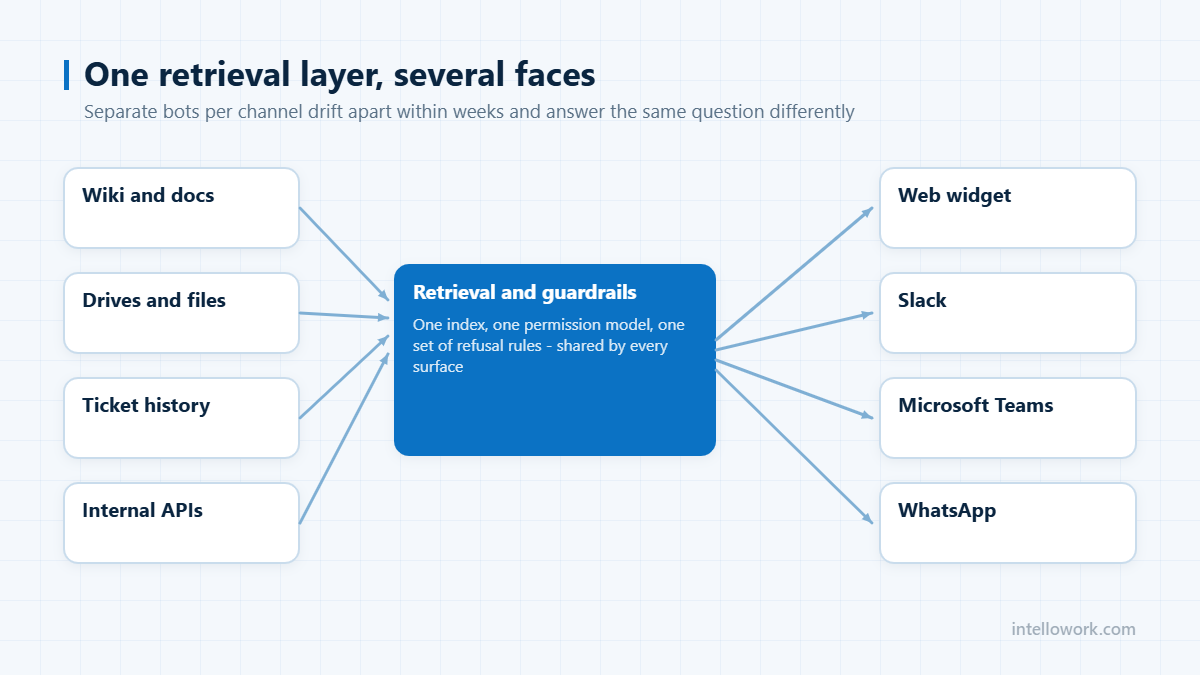
| Channel delivery | One retrieval layer behind a web widget, Slack, Microsoft Teams and WhatsApp, so answers stay consistent everywhere |
| Evaluation and monitoring | Graded question sets, refusal-rate tracking and failure logs, so quality is measured rather than assumed |
The capabilities that separate platforms in practice are the boring ones. Connector depth, permission enforcement and refusal behaviour decide whether a deployment survives its second month.
Where enterprises deploy it first
- Employee helpdesk. HR and IT questions answered from the current handbook and runbooks, with clean escalation for anything case-specific. See AI chatbot for HR and AI chatbot for the IT helpdesk.
- Internal knowledge search. One place to ask across every system, instead of guessing which wiki holds the answer. See enterprise knowledge search.
- Customer support deflection. Grounded answers on the public site and in the product, with agents receiving full context on handover. See AI chatbot for customer support.
- Sales and product enablement. Accurate product, pricing and policy answers drawn from the documents the product team maintains.
- Developer and API support. Answers grounded in your own reference documentation. See AI chatbot for API documentation.
Security, privacy and data residency
Enterprise buyers ask the same five questions, and they are the right ones.
- Where does the index live? Deployment can be scoped to a region so that content and embeddings stay within your residency requirements.
- Is our content used for training? No. Retrieval reads your content to answer a question; it is not training data.
- How are permissions enforced? At query time, against the source system’s access model, with restricted content excluded from retrieval rather than filtered out afterwards.
- What is retained, and for how long? Transcript and log retention is configurable, and deletion reaches derived stores – vector index, evaluation sets and analytics – not only the primary log.
- Does it satisfy Indian data protection rules? Consent, notice, retention and erasure obligations under the DPDP Act are covered in DPDP Act consent rules for AI chatbots.
The deeper security checklist is in enterprise AI chatbot security and compliance, and the private-deployment question in private ChatGPT for enterprises.
How deployment actually runs
| Stage | Typical duration | Output |
|---|---|---|
| Scope and question set | Week 1 | 50 real questions with human-written ideal answers |
| Connect sources and map permissions | Weeks 2-3 | Two or three systems indexed, access model tested with a restricted document |
| Tune retrieval and evaluate | Weeks 3-4 | Graded score against the question set, content gaps listed |
| Pilot with real users | Weeks 5-8 | Deflection, escalation and correctness measured weekly |
| Expand | Month 3 onward | More sources, more channels, decided on evidence |
Almost none of that time is model work. It is content and permissions, which is why scoping to one department first is the single most reliable predictor of a deployment that lasts. The full playbook is in how to run an AI chatbot pilot.
What it costs
Pricing is quoted against scope rather than published as a list, because the variables that move it are the number of connected systems, the size of the corpus and the number of people using it. Three cost lines to budget for:
- Platform – per seat or per deployment, depending on whether the audience is a department or the whole company.
- Integration – connecting systems that do not have a ready connector, and mapping the access model.
- Content – the clean-up work that no platform can do for you, and the line item most first deployments underestimate.
The commercial models across the category, and how to compare them fairly, are broken down in enterprise chatbot pricing.
How to evaluate IntelloWork against alternatives
Do not take our word for any of the above. Run the same test on every platform you shortlist:
- Fifty real questions from your helpdesk queue, with a human-written grading key.
- Ten questions with no answer in your content – count the confident fabrications.
- Five questions only certain roles should be able to answer – check that restricted content does not leak through answers, citations or titles.
- The same three sources connected on every platform, so the comparison means something.
- A re-run a week later, once the index is warm and the content has changed.
The category map and the scoring sheet are in top enterprise knowledge search tools and how to choose enterprise search tools.
Frequently asked questions
What is an enterprise AI chatbot platform?
Software that answers questions from an organisation’s own content rather than from a general model’s training data. It indexes internal systems, retrieves the relevant passages when a question is asked, generates an answer grounded in those passages, and enforces the same access permissions the source systems do. The enterprise part is the permissions, the citations and the auditability – not the conversation.
How is this different from ChatGPT or Microsoft Copilot?
General assistants answer from what they were trained on plus whatever you paste in, and their coverage stops at their own ecosystem. A retrieval platform answers from your systems, across vendors, with access control enforced per answer and a citation attached. For content that is confidential or spread across more than one vendor, that difference decides whether the tool is usable at all. The comparison is worked through in the guide to ChatGPT for company documents.
Which systems can it connect to?
Wikis and document stores such as Confluence, SharePoint and Google Drive; ticketing and CRM systems; and internal APIs for live data such as ticket status or stock levels. Content that changes hourly is read from the system of record at query time rather than indexed. The integration layers are described in the AI chatbot integration guide.
How long does it take to go live?
A scoped pilot on one department’s content typically reaches real users in four to six weeks. Connecting the first sources takes days; the time goes into permission mapping, content clean-up and getting answer quality to a level people trust.
Does it work in languages other than English?
Yes, and across them. A question asked in Hindi retrieves the answer from an English policy document, because retrieval happens in a shared multilingual vector space rather than by translating the query first. The mechanics are explained in multilingual AI chatbot.
What happens when it does not know the answer?
It says so and routes the user onward, rather than generating something plausible. Refusal behaviour is measured as a first-class metric, because an assistant that answers everything confidently is the one people stop trusting. The controls behind this are in stopping AI chatbot hallucinations.
Talk to us
If you want to see this against your own content rather than a demo corpus, the fastest path is a scoped pilot on one department. Request access at intellowork.com.
For the business case behind a rollout, see our model for enterprise AI chatbot ROI.