
Enterprise Chatbot Pricing in 2026: The Four Models, and What You Are Actually Paying For
Updated 14 October 2026
Enterprise chatbot pricing in 2026 comes in four shapes: per resolution, per seat, a platform fee, and building it yourself. Each one is a bet on a different variable, and the vendor picks the model that makes their economics look best against yours. The list price is rarely the number that matters. What matters is the total cost at your actual volume, in your third year, including the two or three line items that never appear on a pricing page.
This guide breaks down the four models, what each one is really charging you for, where each becomes expensive, and the five questions that surface the real number in a vendor call.
If you want figures rather than models, we publish ours: what support automation costs in India, in rupees, with the arithmetic for working out your own number.
The four pricing models at a glance
| Model | You pay for | Cheap when | Expensive when |
|---|---|---|---|
| Per resolution | Each conversation the AI closes | Volume is low or seasonal | Volume grows, or definitions of “resolved” are loose |
| Per seat | Each human user or agent licence | Small team, high volume each | Whole-organisation internal rollouts |
| Platform fee | Capability, connectors and capacity | Volume is high and growing | Volume is small, or you need one narrow use case |
| Build it | Engineers, infrastructure and time | You already have an ML platform team | Always, by year two, if you do not |
1. Per resolution
Common in customer-support AI. You pay a fixed amount, often in the range of a dollar or two, each time the assistant closes a conversation without a human. The pitch is compelling because it maps directly onto the cost of a human ticket, which is usually several times higher.
Where it bites. The definition of “resolution” is the whole contract. Ask precisely: is a session counted as resolved if the user never replied? If they came back four hours later with the same question? If they clicked through to a human immediately after? Vendors differ, and the difference between a generous and a strict definition can be 30 percent of your invoice.
The second problem is that it penalises success. As the assistant gets better and handles more, your bill rises in lockstep. That is defensible when it is displacing agent cost. It is much less defensible for an internal assistant, where the displaced cost is diffuse employee time rather than a headcount line.
Before signing, model your bill at three times current volume. If the number is uncomfortable, negotiate a volume tier or a cap now, while you still have leverage. And read our note on true deflection versus reported deflection – you do not want to pay per resolution on a metric that overstates itself by a fifth.
2. Per seat
Standard for suites, where the assistant is a module bolted onto a product you already licence. Simple to forecast, easy to approve, and it fits procurement’s existing mental model.
Where it bites. Per-seat pricing is fine when the seats are a support team of forty. It is a disaster for an internal knowledge assistant, because the whole point of that deployment is that everyone uses it. At 3,000 employees, a modest per-seat figure becomes a number your CFO will not sign, and the usual response – licensing only a subset of staff – destroys the value proposition. An assistant that only some employees may ask is not an answer layer; it is a departmental tool.
Watch also for seat definitions that count anyone who interacts, not just administrators, and for tiering that puts the connector you actually need one tier above the one you were quoted.
3. Platform fee
Typical of knowledge-grounded answer platforms. You pay an annual fee for the capability – connectors, retrieval, permissions, the answer layer – usually banded by document volume, query volume or number of connected systems, with unlimited or generously bounded end users.
Where it bites. The floor. Platform pricing rarely goes low enough to be sensible for one small use case, so if you want a chatbot on a marketing site and nothing else, you are overbuying. The other risk is band definitions: check whether the band is measured on documents indexed, pages, chunks or storage, because the same corpus can land in different bands under different definitions.
Where it wins. Cost stops tracking success. You can push adoption across the organisation, connect a fourth and fifth system, and encourage people to ask more questions without the bill responding. For internal deployments that is usually the right incentive structure, because you want usage to grow.
4. Build it yourself
The retrieval pipeline is genuinely not hard any more. A capable engineer can have a working demo over a document set in a fortnight, which is exactly why so many organisations start here and why the true cost is so consistently underestimated.
The demo is not the product. The product is connectors that stay authenticated and preserve permissions when a source system changes its API, incremental re-indexing, a permissions model that survives an audit, an evaluation harness, monitoring, an admin interface someone other than the author can operate, and three years of somebody owning all of it. Model tokens are usually the smallest line in the budget.
Building is the right answer when retrieval is core to your own product, when you have an existing platform team with production RAG experience, or when a residency or air-gap requirement rules out every vendor. It is the wrong answer when the business case rests on the assumption that the demo was 80 percent of the work.
The hidden costs that never appear on a pricing page
| Hidden cost | Typical trigger | How to defuse it |
|---|---|---|
| Implementation and onboarding | Charged separately, often a large one-off | Get it quoted in the first proposal, not the second |
| Connectors | Priced per source system, or gated to a higher tier | List every system you will connect in year two, now |
| Content preparation | Your own team, cleaning and deduplicating documents | Budget internal weeks, not just licence money |
| Overage | Charged at a punitive rate above the band | Negotiate the overage rate, not just the band |
| SSO and audit logging | Enterprise tier only, at several times the price | Confirm which tier includes SAML and export logs |
| Data egress on exit | Discovered at renewal | Get an export clause covering documents, embeddings and logs |
| Internal ownership | Someone must own content freshness forever | Name that person before you buy |
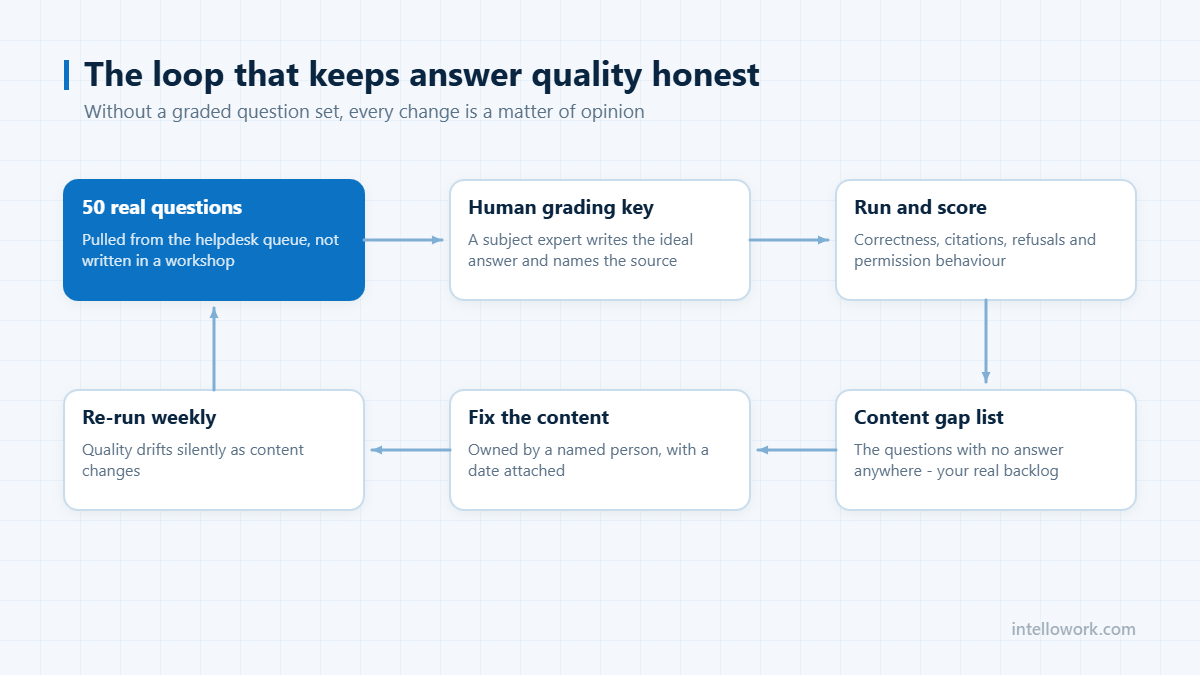
That last row is the one that decides outcomes more than price does. An assistant with no owner degrades quietly as content ages, and the organisation concludes the technology failed. The monitoring setup that surfaces content gaps is only useful if a named person works the list.
Five questions that surface the real price
- Show me this quote at three times my current volume. If the model punishes growth, you want to know in the first meeting.
- What exactly counts as a resolution, a seat, or a document? Get the definition in the contract, not the deck.
- Which of these connectors are in the tier you have quoted me? Connector gating is the most common surprise.
- What is included in implementation, and what is billed separately? Ask for the professional services line explicitly.
- What does year three look like, and what happens if we leave? Uplift caps and data export both belong in the first negotiation.
How to compare across models
The only fair comparison is three-year total cost of ownership at your projected volume, including internal effort. Build the model with four columns – licence, implementation, internal people, and growth scenario – and fill it for each shortlisted vendor plus a build option. Most of the time the ranking changes once internal effort is included, and it changes again at year three.
Then set the value side against it. For a customer-facing deployment that is deflected contacts times fully loaded contact cost. For an internal assistant it is harder but not impossible: time saved per query times query volume, discounted heavily, plus the tickets that never got raised. Establish the baseline before launch, as described in running a 30-day pilot, or you will be arguing from anecdote at renewal.
Frequently asked questions
How much does an enterprise AI chatbot cost?
It depends far more on the pricing model than on the vendor. Per-resolution pricing scales with conversation volume, per-seat with user count, and platform fees with corpus and connector count. Rather than asking for a single number, model three-year total cost of ownership at your projected volume including implementation, connectors and internal effort.
Which pricing model is best for an internal employee assistant?
Usually a platform fee. Internal assistants only deliver value when the whole organisation uses them, so per-seat pricing works against the goal and per-resolution pricing makes your bill rise as adoption improves. A capability-based fee lets you encourage usage without a cost penalty.
What does “per resolution” actually mean?
It varies by vendor, which is why it must be defined in the contract. Ask specifically whether a session counts as resolved when the user does not reply, when they return with the same question hours later, and when they escalate to a human immediately afterwards. Those three cases can move an invoice by around a third.
Is building our own chatbot cheaper than buying one?
Rarely, unless retrieval is core to your own product or you already run a platform team with production RAG experience. The demo is cheap; connectors, permission models, incremental indexing, evaluation, monitoring and three years of ownership are not. Compare against total cost of ownership, not licence price.
What hidden costs should we budget for?
Implementation and onboarding fees, per-connector charges or tier gating, internal content preparation time, overage rates above your band, SSO and audit logging often restricted to enterprise tiers, data egress on exit, and a named internal owner for content freshness. The last one is unpriced and decides whether the deployment succeeds.
How do we justify the spend internally?
Capture a baseline before launch: ticket volume by category, median resolution time, and fully loaded cost per contact. After launch, report true deflection with 48-hour re-contacts subtracted, alongside escalation quality improvements. A defensible smaller number survives renewal; an inflated one does not.
Next step
Take the five questions above into your next three vendor calls, including one with IntelloWork, and write the answers down. The vendors who answer precisely are the ones whose pricing will still make sense in year three. See also our category breakdown of enterprise AI chatbot platforms.
Price is only half the question. For the other half, see our model for enterprise AI chatbot ROI.