Enterprise Chatbot Use Cases: 12 That Actually Ship (and 3 That Usually Fail)
Updated 4 September 2026
Most lists of enterprise chatbot use cases are wish lists. This one separates the twelve that reliably reach production from the three that consistently stall, and gives the test that tells you which category a new idea belongs to before you spend a quarter finding out.
The test
A use case ships when three things are true: the answer already exists in writing or in a system, the question repeats often enough to be worth automating, and being wrong is recoverable. Fail any one and the project stalls – usually at the pilot-to-production boundary, where the failure is expensive and public.
Twelve that ship
| Use case | Why it works | Watch out for |
|---|---|---|
| HR policy questions | Written down, repetitive, high volume | Country and grade variations |
| IT L1 knowledge requests | Runbooks exist, questions repeat | Stale runbooks |
| Onboarding for new joiners | Same questions every single time | Content scattered across teams |
| Sales enablement lookups | Battlecards and pricing already exist | Version control on pricing |
| Product and API documentation | Structured, authoritative source | Version-aware retrieval |
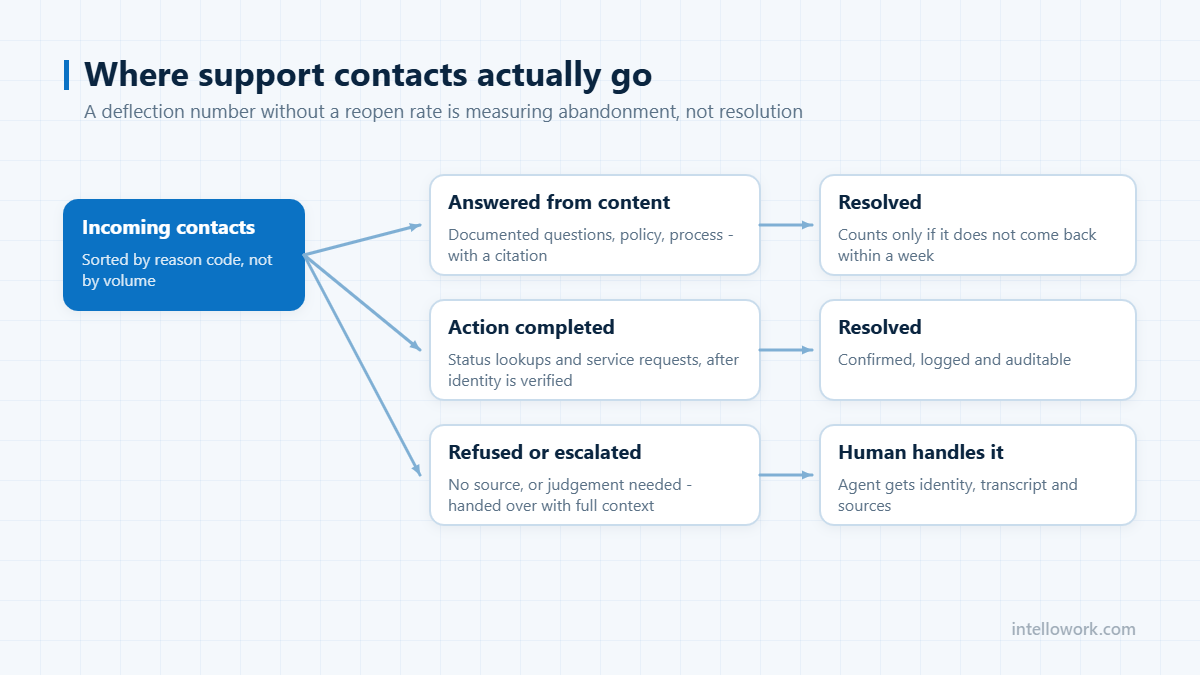
| Customer support deflection | Help centre plus ticket history | Honest refusal behaviour |
| Internal wiki search | Content exists, findability does not | Space-level permissions |
| Procurement and expense policy | Rules-based and well documented | Approval thresholds change |
| Compliance and SOP lookup | Documents are authoritative by design | Must cite the clause, always |
| Ticket triage and enrichment | Improves handoffs even without deflection | Measured badly, or not at all |
| Status and order lookups | Single API call, unambiguous answer | Live data, never cached |
| Field and frontline reference | Manuals exist, hands are busy | Channel constraints, offline gaps |
Note how many of these are the same technical capability pointed at different content. That is the point: one retrieval layer with permission-aware scopes serves most of the table, which is why buying twelve point solutions is the expensive way to do this.
Three that usually fail
Undocumented expertise. “Ask the assistant why we architected it this way.” The answer is in three senior engineers’ heads and a Slack thread from 2023. Retrieval cannot surface what was never written. This becomes viable only after a documentation effort, and at that point the documentation was the win.
Judgement calls dressed as questions. “Should we approve this discount?” “Is this candidate a fit?” These need context the documents do not hold and carry consequences that are not recoverable. Assistants can surface the policy and the precedents; they should not render the verdict.
Full transaction automation on day one. Raising the ticket, applying the leave, updating the record – all defensible eventually, all a mistake as a first deployment. Read paths earn the trust that write paths spend. See transactional chatbot flows for how to sequence it.
How to choose your first one
Pick the use case with the highest ratio of question volume to content chaos. High volume over tidy content is the ideal first deployment even if it is not the most strategically exciting, because it produces a measurable win in weeks and buys you the credibility for the harder ones. HR policy and IT L1 are the two most common winners – see HR and IT helpdesk.
Why the same twelve keep appearing
Look down the list of use cases that ship and a pattern emerges that has nothing to do with the department. Every one of them is a case where an organisation already paid to create the answer – someone wrote the policy, someone closed the ticket, someone maintained the runbook – and then failed to make that answer findable at the moment it was needed. The assistant is not creating knowledge. It is recovering the value of knowledge you already bought and then mislaid.
This reframing is useful in budget conversations, because it changes the question from “how much will AI cost us” to “how much are we already spending to answer the same question repeatedly”. A support organisation that answers the same forty questions ten thousand times a year has an obvious arithmetic problem, and the arithmetic does not depend on any claim about what models will be able to do next year.
It also explains the failures. The three that stall all violate the same premise: the answer was never created in the first place, or it requires judgement that no document encodes, or the action is irreversible so recovering a wrong answer is not possible. No amount of model capability changes those constraints.
Sequencing across a portfolio
Once the first use case is live, the marginal cost of the second is much lower than the first, provided you built on a shared retrieval layer rather than a point solution. The connectors exist, SSO is wired, the evaluation harness is running, and the operational habit of working a content gap list has been established. Adding sales enablement to an assistant that already serves IT is largely a content and permissions exercise.
That economics is the strongest argument against buying a separate tool per department. Four point solutions means four indexes, four permission models, four content freshness problems and four sets of metrics that cannot be added together. It also guarantees the answer drift problem: the same policy question asked in two tools returning two different answers, discovered by an employee rather than by you.
A reasonable portfolio sequence for a mid-sized organisation: IT L1 or HR policy first, because volume is high and content is tidy; onboarding second, because it reuses most of the HR corpus; internal wiki and documentation search third, because coverage is now broad enough to be genuinely useful; then customer-facing deflection, which needs a different permission scope but the same machinery. Transactional flows come after all of that, one at a time.
How to kill a use case early
The expensive failure is not the idea that never started. It is the idea that ran for two quarters before anyone admitted it was not working. Set a kill criterion at the outset, expressed in the same terms as your success criterion: if retrieval recall on the evaluation set cannot be brought above a stated threshold within a stated number of weeks, the use case is parked and the reason is documented.
Usually the documented reason will be a content gap, which is valuable information regardless. A use case that fails because the source material does not exist has told you exactly what to write, and it may be worth writing. What it should not do is quietly absorb another quarter of engineering time on prompt revisions.
Frequently asked questions
What is the best first enterprise chatbot use case?
Usually HR policy questions or IT level-one knowledge requests. Both have high repeat volume, answers that already exist in writing, and recoverable consequences when wrong. Pick the one where your content is tidiest, not the one that sounds most strategic.
Which chatbot use cases usually fail?
Three patterns: questions whose answers were never written down, judgement calls with unrecoverable consequences such as approvals and hiring decisions, and full transaction automation attempted as a first deployment before the read-only path has earned trust.
How do we know if an idea will work before building it?
Apply three tests. Does the answer already exist in a document or a system? Does the question repeat often enough to justify automation? Is being wrong recoverable? A no to any of the three predicts a stall at the pilot-to-production boundary.
Next step
Score your candidate use cases against the three tests, then pilot the highest scorer. IntelloWork covers most of the twelve with one retrieval layer rather than twelve point tools.
To turn these use cases into a number, see our model for enterprise AI chatbot ROI.