
AI Chatbot for Customer Support
Updated 1 September 2026
An AI chatbot for customer support is judged on one number: how many contacts it resolves correctly without a human, without making anything up. Everything else – tone, avatars, suggested replies – is decoration on top of that.
This page covers how support automation is scoped, what it realistically deflects, how handover should work, and how to measure it so the number you report to the business survives scrutiny.
What actually gets deflected
Support volume is not uniform, and the automatable share is more predictable than most teams expect. Sort last quarter’s tickets by reason code and the pattern appears immediately.
| Contact type | Automatable | Why |
|---|---|---|
| Documented “how do I” questions | High | The answer exists in your help centre and does not change per customer |
| Order, ticket or account status | High | A live lookup against the system of record, once identity is established |
| Policy questions – returns, warranty, billing terms | High | One authoritative document, provided it is current |
| Troubleshooting with a decision tree | Medium | Works when the tree is written down; fails when it lives in agents’ heads |
| Billing disputes and refunds | Low | Judgement and money – confirmation and approval required |
| Complaints and escalations | None | The point of the contact is to reach a person |
A realistic first target is the top ten reason codes, not the whole queue. Teams that aim at everything usually ship something that half-answers all of it.
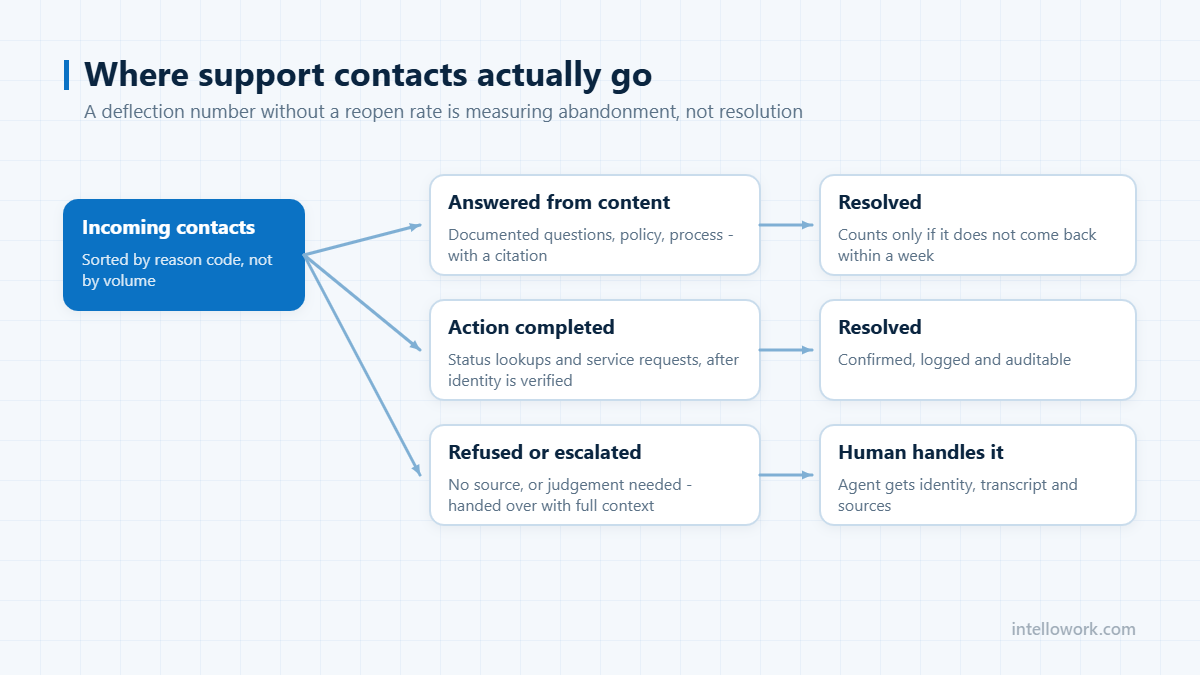
Grounding: the difference between deflection and damage
A support assistant that invents an answer does not save a contact; it creates a second, angrier one. Grounding is what prevents that: the assistant retrieves passages from your help centre, policy documents and resolved tickets, then answers only from those passages, with a citation attached.
- Index resolved tickets, not just help articles. The real answer to an unusual question is often in a ticket an agent closed, phrased the way customers actually ask it.
- Keep one source of truth per policy. Three versions of the returns policy in three places is a content problem no retrieval system can resolve for you.
- Measure refusal deliberately. Put ten unanswerable questions in your test set and count the confident fabrications. That number predicts customer trust better than any accuracy score.
The full set of controls is in stopping AI chatbot hallucinations.
Identity, and what it unlocks
Half of support volume is account-specific, and none of it can be answered safely without knowing who is asking. What the assistant may do follows directly from how strong that identity is.
- Logged-in web or in-app. Session identity inherited; account-specific answers and transactional flows are both available.
- Anonymous website visitor. Public content only, with a clean route to sign in for anything account-specific.
- Email. An address is spoofable, so treat it as weak identity – and remember there is no clarifying turn, so the first reply has to stand alone.
- WhatsApp. A phone number and a session window; a step-up check before any account action. See WhatsApp AI chatbot for business.
The rule that keeps this safe: the weaker the identity, the smaller the set of questions the assistant is allowed to answer. Channel-by-channel detail is in AI chatbot channels.
Handover that agents do not resent
Most support automation is judged by agents, and agents judge it on handover. Three things have to arrive with the conversation:
- The verified identity and the account it maps to, so nobody re-asks for an order number.
- The full transcript plus the sources the assistant retrieved, so the agent can see what the customer was already told.
- The reason for the handover – refused, escalated by the customer, or a failed action – and the exact point of failure.
Handover should also be available on demand. An assistant that makes a frustrated customer argue their way to a human converts a deflection into a complaint.
Beyond answering: doing
Status lookups, address changes, appointment bookings and ticket creation are where deflection numbers get materially better – and where the risk starts, because the assistant is now writing to your systems. Every safe flow follows the same pattern: establish identity, validate each parameter against the source system, restate the whole action in plain language before executing, execute once with an idempotency key, and log it.
Business rules belong in the API, never in the prompt: a model can be talked around, a server-side limit cannot. The full design pattern is in transactional chatbot flows and campaigns.
Measuring it honestly
| Metric | Definition that survives scrutiny |
|---|---|
| Deflection rate | Conversations resolved with no human contact within 24 hours – not conversations that simply ended |
| Answer correctness | Weekly sample graded by someone who knows the subject, against a written key |
| Fabrication rate | Confident answers to questions with no source, measured against a fixed unanswerable set |
| Handover quality | Share of escalations where the agent had to re-ask something the assistant already knew |
| Reopen rate | Deflected contacts that come back within a week – the metric that catches false deflection |
Reopen rate is the one to insist on. A deflection number that only ever goes up, with no reopen tracking behind it, is measuring abandonment rather than resolution. The monitoring routine is in monitoring internal AI assistants.
Frequently asked questions
What percentage of support tickets can an AI chatbot handle?
It depends almost entirely on how much of your knowledge is written down and current, not on the model. Teams with a maintained help centre and clean policy documents automate a substantial share of documented “how do I” and status questions; teams whose answers live in agents’ heads automate very little until that content exists. Sort last quarter’s tickets by reason code before estimating – the answer is in your own data.
Will an AI chatbot make things up to customers?
It will if it is not grounded and not measured. A retrieval-based assistant answers only from passages found in your content and cites them, and refuses when nothing matches. The safeguard is to test refusal explicitly: keep a fixed set of questions with no answer in your corpus and track how many get a confident response.
How does it hand over to a human agent?
By passing the verified identity, the full transcript, the sources it retrieved and the reason for the handover into your existing ticketing or live-chat tool, so the agent starts with context rather than a link to open. Customers should also be able to ask for a human at any point and get one.
Can it answer questions about a specific order or account?
Yes, once identity is established through the channel and the assistant is connected to your system of record. Live values such as order status are read at query time rather than indexed, so the answer reflects the system rather than a stale copy.
How long does it take to deploy customer support automation?
A scoped deployment covering the top reason codes typically reaches customers in four to six weeks. Most of that time is content and permission work rather than configuration – which is also why starting with ten reason codes beats starting with the whole queue.
See it on your own content
The fastest way to size this is a pilot against your real ticket history and help centre. Request access at intellowork.com, or start with the enterprise AI chatbot platform overview.