
Beyond Q&A: Transactional Chatbot Flows and Campaigns
Updated 1 September 2026
A transactional chatbot does not just answer – it does something. Raises the ticket, books the slot, applies the leave, updates the record, sends the campaign. That is where the measurable value is, and it is also where the risk changes shape entirely, because a wrong answer is recoverable and a wrong action often is not.
Answering and acting are different products
Answering is read-only, reversible, and wrong answers cost credibility. Acting writes to systems, is frequently irreversible, and wrong actions cost money, time or trust with a customer. They need different design, different testing and different approval.
The practical consequence is sequencing. Run the read path for months first. It builds the retrieval quality, the permission model and the organisational trust that the write path spends. Teams that ship transactions in month one are borrowing against credibility they have not earned.
Anatomy of a safe transactional flow
- Intent recognition. Establish what the user wants, and confirm it in plain language before collecting anything.
- Identity and entitlement. Verify who is asking and whether they may do this. Execute as that user, never as a broad service account.
- Slot collection. Gather the required fields conversationally, validating as you go rather than at the end.
- Explicit confirmation. Show exactly what is about to happen, in full, and require an affirmative response. No implied consent, no timeouts that proceed.
- Execution with idempotency. A retry must not create two leave requests or two orders.
- Receipt and audit. Confirm what happened, give a reference, and log the whole chain for later reconstruction.
- Reversal path. State how to undo it, and make that path work.
Step four is the one most often weakened for the sake of a smoother flow, and it is the one that matters most. Any action with side effects needs a human affirmation showing precisely what will occur – this is also the primary defence against instructions smuggled in through retrieved documents, as described in our security checklist.
Campaigns are a separate discipline
Outbound is not inbound with the direction reversed. It carries consent obligations, channel-specific rules and a much lower tolerance for error, because a mistake reaches thousands of people simultaneously rather than one.
Three requirements. Consent must be recorded, per channel, with a timestamp and a source, and honoured on withdrawal. Channel rules must be respected – on WhatsApp, business-initiated messages outside the customer service window require approved templates, and misuse damages your sender quality, not just one campaign. And segmentation should be conservative: send to a small cohort, read the responses, then widen. See the WhatsApp guide for channel specifics.
What to automate first, and what never
| Action | Verdict | Why |
|---|---|---|
| Raise a ticket with context | First | Reversible, high volume, immediately useful |
| Book or reschedule an appointment | Early | Bounded, easily reversed, clear confirmation |
| Apply leave or submit an expense | Later | Touches records; needs entitlement checks and audit |
| Update a CRM or master record | Later, scoped | Downstream effects are hard to see from the chat |
| Issue a refund or payment | Human approves, always | Irreversible and financially material |
| Change access or permissions | Never automate | Prime social-engineering target |
The confirmation pattern, step by step
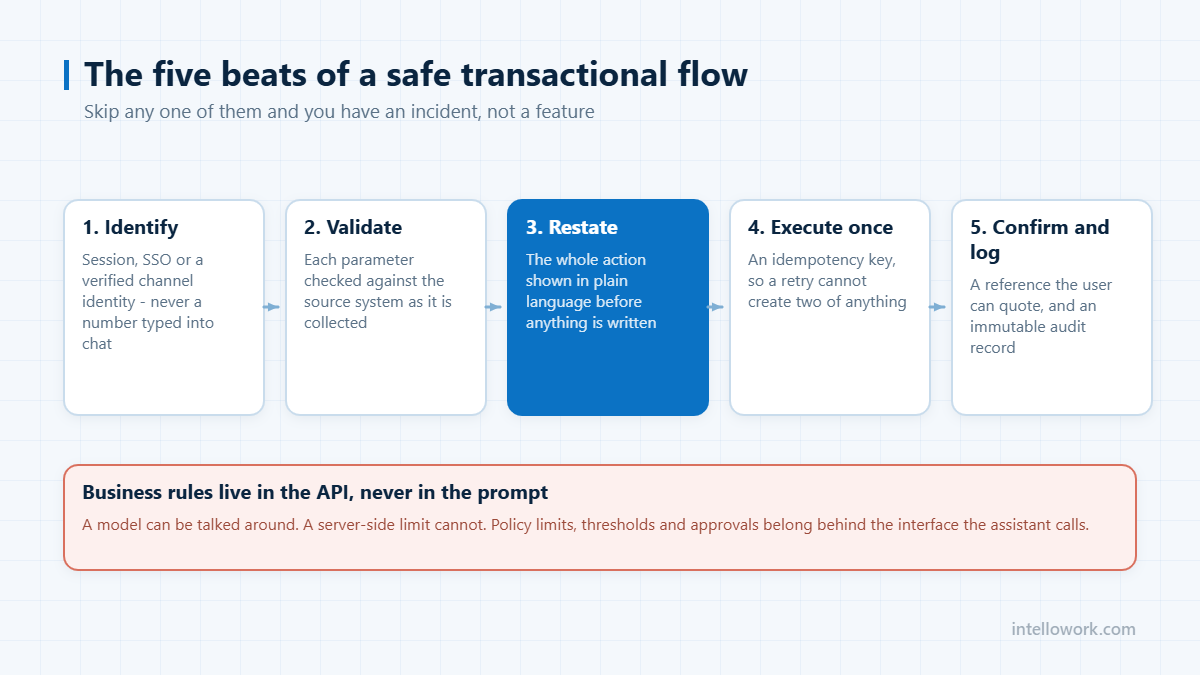
Every safe transactional flow, whatever it does, follows the same five beats. Skipping any one of them is where incidents come from.
- Identify. Establish who is asking before anything else. A logged-in session, an SSO token or a verified identity from the channel – never a name typed into the chat.
- Collect and validate. Gather each parameter and validate it against the source system as you go, not at the end. Wrong dates, closed accounts and out-of-policy amounts should fail early, while the user is still in the conversation.
- Restate. Show the complete action in plain language before executing: what will happen, to which record, with what effect. This is the step that turns an ambiguous request into an auditable one.
- Execute once. Use an idempotency key so a retry, a double tap or a dropped connection cannot create two of anything.
- Confirm and log. Return a reference the user can quote, and write an audit record that ties the action to the identity, the timestamp and the exact confirmation text shown.
The restatement step is worth defending in design review. It costs one turn in the conversation and it removes almost every category of “the bot did something I did not ask for” complaint.
What a transactional flow actually touches
An answering assistant reads. A transactional one writes, which means it inherits the constraints of every system it writes to.
| Layer | What it must provide | Common failure |
|---|---|---|
| Identity | Verified user, mapped to the record owner in the target system | Chat identity and system identity never reconciled |
| Authorisation | Permission to perform this action, not just to read the record | Read scope reused for write operations |
| Business rules | Policy limits enforced server-side | Limits implemented in the prompt, where they can be talked around |
| Execution | Idempotent write with a reference returned | Retries creating duplicate records |
| Audit | Immutable log of identity, action, parameters and confirmation | Only the chat transcript is kept, and it is editable |
The rule that survives contact with production: business rules live in the API, never in the prompt. A model can be persuaded; a server-side limit cannot. The integration groundwork for this is the same as for read-only assistants and is covered in enterprise chatbot integrations for SSO, SAP and Salesforce.
When something fails halfway
Partial failure is the normal case, not the edge case. A flow that books a slot, charges a fee and sends a confirmation can fail after step two, and the user is still sitting in the conversation waiting.
- Decide the compensating action in advance for each step that can fail after a write. Automatic reversal, a queued correction, or an immediate handover – but decided at design time, not improvised by the model.
- Never let the assistant narrate a failure it cannot verify. “Your refund has been processed” from a flow that did not get a success response is worse than an honest handover.
- Hand over with context. When the flow stops, the human who picks it up should receive the identity, the parameters collected and the exact point of failure, not a transcript to read.
- Alert on stuck flows, not just on errors. Flows that start and never complete are the signal that a step is confusing or an integration is timing out.
Instrumenting all of this is the same discipline described in monitoring internal AI assistants: log the decision, not just the output.
Frequently asked questions
What is a transactional chatbot?
One that completes actions in your systems rather than only answering questions – raising tickets, booking appointments, submitting requests, updating records or running outbound campaigns. It requires identity verification, explicit confirmation, idempotent execution and a full audit trail.
When should we add transactional flows?
After the read-only answering path has run reliably for months. The read path builds the retrieval quality, permission model and organisational trust that write actions depend on. Add one action at a time, starting with reversible, high-volume ones such as raising a ticket.
What should a chatbot never be allowed to do?
Change access rights or permissions, which is a prime social-engineering target, and issue refunds or payments without human approval, which is irreversible and financially material. Anything with unrecoverable consequences should end with a person clicking the final button.
How do consent rules affect chatbot campaigns?
Consent must be recorded per channel with a timestamp and source, and honoured immediately on withdrawal. Channels impose their own rules – business-initiated WhatsApp messages outside the customer service window require pre-approved templates, and misuse harms your sender quality beyond the individual campaign.
How should a transactional chatbot authenticate users?
Through the channel’s own identity, not through the conversation. On a logged-in web or app surface, inherit the session. In Slack or Teams, map the workspace identity to the system identity once and store the mapping. On WhatsApp or SMS, where the phone number is the only signal, require a step-up check before any write action. Asking a user to type an account number into a chat is not authentication.
What happens when the underlying API call fails?
The assistant should say what it knows and nothing more: that the action did not complete, what was and was not done, and what happens next. Every step that writes needs a defined compensating action and an idempotency key so retries cannot duplicate the record. Silence and optimistic confirmations are the two responses that turn a failed transaction into a support incident.
Which transactional flows need human approval?
Anything irreversible, anything involving money above a defined threshold, anything affecting another person’s record, and anything with a regulatory consequence. A useful test: if reversing the action requires a phone call to a human, a human should have approved it. Everything else can run automatically with a clear confirmation step and an audit trail.
How are chatbot campaigns different on WhatsApp?
Outbound messaging on WhatsApp runs on pre-approved templates, opt-in records and session windows, and the platform enforces them. That makes campaign design a compliance exercise before it is a marketing one: consent captured with a clear purpose, templates approved ahead of the send, and an opt-out that works on the first attempt. The channel-specific detail is in the WhatsApp AI chatbot for business guide.
Next step
Pick one reversible action, build the seven-step flow around it properly, and run it for a quarter before adding a second. IntelloWork handles the answering layer these flows sit on top of.