
Multilingual AI Chatbot: Answer in Any Language, Whatever Language Your Docs Are In
Updated 1 September 2026
A multilingual AI chatbot answers in the language the person asked in, even when every document it draws on is written in another. That is the requirement most enterprises actually have: policies and product documentation in English, and users asking in Hindi, Tamil, German, Arabic or Spanish. The naive solution – translate the question, search, translate the answer – fails precisely where it matters, because domain vocabulary is what machine translation handles worst.
The architecture that works removes translation from the retrieval path entirely.
Why translate-search-translate breaks
Three compounding failures, each small on its own.
Terminology drift. A translation engine renders your domain terms into ordinary words. A user asks about a specific benefit or product component; the translated query uses a generic synonym; retrieval matches nothing useful. The nouns that carry the meaning are exactly the nouns that get translated loosely.
Error stacking. Translation into English, retrieval, generation, then translation back. Each step is individually decent and the composition is not. A small distortion at step one becomes a wrong document at step two and a confidently wrong answer at step four.
Code-mixing. Real users do not write in one clean language. Hinglish, Arabizi, and English technical terms embedded in a German sentence are the norm in enterprise settings. A translation step forces a language label onto text that does not have one, and picks wrong often enough to matter.
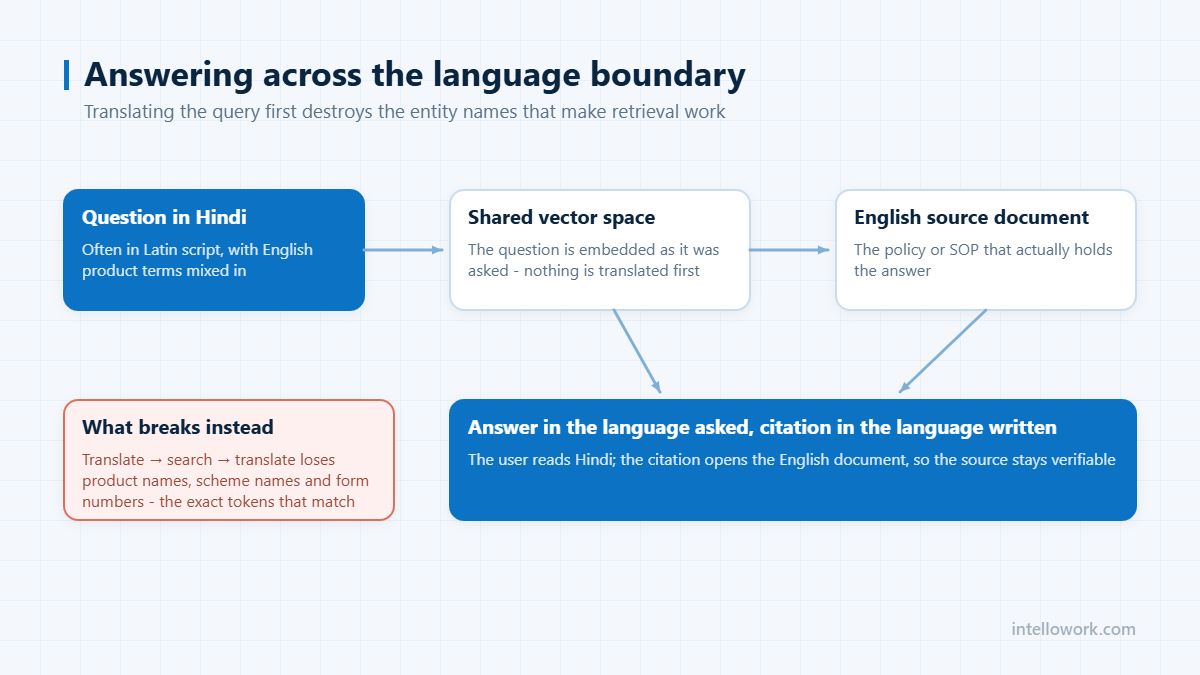
The architecture that works
Language independence has to live in the embedding layer, not in a translation service bolted to either end.
| Layer | Requirement | Why |
|---|---|---|
| Embeddings | Multilingual model, shared vector space | A Hindi question lands near the English clause that answers it |
| Retrieval | Query the whole corpus, not a per-language index | The answer may exist in only one language |
| Reranking | Cross-lingual reranker | Prevents same-language results being unfairly favoured |
| Generation | Answer in the asker’s language, cite the original | Reader gets a usable answer and a verifiable source |
| Refusal | Refuse in the asker’s language too | An English refusal to a Tamil question reads as a fault |
The reranking row is the one teams miss. Even with multilingual embeddings, a bilingual corpus will tend to rank same-language passages higher. If your German documents are thinner than your English ones, German users quietly get worse answers, and nobody reports it because the answers look fine. A cross-lingual reranker with language fairness is what stops that. The general retrieval pattern is covered in retrieval-augmented generation.
Citation across languages
When the answer is generated in Hindi from an English source, what do you cite? The honest answer is the English original, labelled as such, with a note that the answer was produced from it. Never present a machine translation of a policy clause as though it were the policy. In regulated contexts the source language document is the authoritative one, and the reader needs to know which text actually governs.
A good pattern: answer in the user’s language, show the cited passage in its original language, and offer an on-demand translation of that passage clearly labelled as a translation.
Where multilingual retrieval earns its keep
- Distributed workforces. A corporate office in one language and plants, stores or field teams in several others. HR policy is the highest-volume case – see AI chatbot for HR.
- Global support. One English knowledge base serving customers in a dozen languages, without maintaining a dozen translated help centres.
- Regulated multi-market operations. Local statutory addenda in the local language alongside a group policy in English, where precedence rules matter.
- Post-acquisition integration. Two document estates in two languages that nobody is going to harmonise.
How to test it properly
Do not test with translated questions. Get native speakers to write questions the way they would actually type them, including code-mixed ones, and build the evaluation set from those. Then check three things per language: retrieval recall, whether the correct passage was returned at all; answer accuracy against a hand-written correct answer; and refusal behaviour on questions the corpus cannot answer.
Report the three numbers per language, never averaged. An average hides the language that is failing, and the failing language is usually the smallest user group – which is exactly the group least likely to complain and most likely to quietly stop using the tool.
Which languages are hard, and why
Multilingual retrieval quality is not uniform, and knowing where it degrades tells you where to test hardest.
- Script mixing. Employees write Hindi in Latin script, or mix English technical terms into a Tamil sentence. Retrieval that assumes one script per language misses these entirely, and they are extremely common in real workplace queries.
- Terminology that never translates. Product names, internal system names and policy titles stay in English inside an otherwise translated question. This is usually helpful for retrieval, and systems that aggressively translate the query can destroy the signal.
- Low-resource languages. Embedding quality follows training data. For languages with less representation, expect weaker semantic matching and plan for more literal keyword fallback.
- Morphologically rich languages. Heavy inflection means the same concept appears in many surface forms, which punishes keyword-only retrieval and rewards embeddings.
- Right-to-left rendering. Not a retrieval problem but a delivery one – citations and mixed-direction text break in interfaces that were only ever tested in English.
Where multilingual assistants fail in production
The failures are rarely dramatic. They look like slightly worse answers for one group of users, which is exactly why they persist for months.
| Symptom | Usual cause | Fix |
|---|---|---|
| Answers are correct in English, vague in other languages | Retrieval is fine, generation is falling back to a summary of weaker matches | Measure retrieval and generation separately, per language |
| Non-English questions get “I do not know” more often | Query translated before embedding, losing entity names | Embed the original query; do not pre-translate |
| Citations point to the right document, wrong section | Chunking tuned on English text lengths | Re-tune chunk size per language, or chunk on structure |
| Users switch to English to get better answers | The system works, but only in one language – and adoption data hides it | Track answer quality by query language, not overall |
That last row is the one to watch. When bilingual employees quietly switch to English because the answers are better, your aggregate metrics improve while the product gets worse for the people who needed it most.
Frequently asked questions
How does a multilingual AI chatbot answer from English-only documents?
By embedding questions and documents into a shared multilingual vector space, so a question in one language retrieves the semantically matching passage in another directly, with no translation step in the retrieval path. The answer is then generated in the asker’s language, citing the original source document.
Why not just translate the question and the answer?
Because domain terminology is what translation handles worst, and errors compound across four steps. Translated queries lose the specific nouns that make retrieval work, and code-mixed input, which is normal in real enterprise use, forces a wrong language label onto the text.
Do we need to translate our documents first?
No, and usually you should not. Maintaining parallel translated corpora doubles the freshness problem and creates conflicting versions. Keep one authoritative source, retrieve across languages, and translate only at the point of answering, clearly labelled.
Which language should the citation be in?
The original. Present the answer in the user’s language but cite the source passage in the language it was written in, labelled as authoritative, with optional on-demand translation marked clearly as a translation. In regulated contexts the source language document governs.
How do we know it works equally well in every language?
Test with questions written by native speakers rather than translated ones, and report retrieval recall, answer accuracy and refusal behaviour separately for each language. Never average across languages – the average conceals the language that is underperforming, usually the smallest user group.
How many languages can one assistant realistically support?
Technically, as many as the embedding model covers – often a hundred or more. Operationally, the limit is how many you can evaluate. Each supported language needs its own graded question set and someone who can judge the answers. Most organisations are better served by three or four languages tested properly than twenty claimed and none measured.
Does multilingual support slow the assistant down?
Marginally, and less than the translate-first approach it replaces. Embedding a query costs the same regardless of language, and cross-language retrieval happens in the same vector space. A pipeline that translates the question, searches, then translates the answer back adds two model calls to every turn – so the multilingual-native design is usually the faster one as well as the more accurate one.
Next step
Ask any vendor to demonstrate a question in your users’ language against your English documents, live, and to show the per-language recall numbers. IntelloWork is built around language-independent retrieval with cross-lingual reranking, and that is the demo we would want you to insist on from anyone.