
AI Chatbot for Banking and Financial Services
Updated 1 September 2026
Banks, NBFCs and insurers have the two conditions that make AI assistants valuable and dangerous at the same time: enormous volumes of repetitive questions, and content where a wrong answer has a regulatory consequence. That combination changes what a deployment has to look like.
This page covers where AI chatbots earn their place in financial services, the controls that are non-negotiable, and the use cases worth refusing.
Where the volume is
| Audience | High-volume questions | Fit |
|---|---|---|
| Branch and contact-centre staff | Product terms, eligibility rules, process steps, current circulars | Strong – internal, documented, changes often |
| Operations and back office | SOPs, exception handling, checklist lookups | Strong – answers exist but are buried |
| Compliance and risk teams | Policy retrieval across circulars and internal guidance | Strong – retrieval with citations, human decides |
| Customers – servicing | Statement, status, charges, documented policy questions | Good, once identity is established |
| Customers – advice | Which product should I buy, is this a good investment | Refuse – regulated advice, route to a licensed human |
The highest-return first deployment in most financial institutions is internal, not customer-facing. Branch staff answering from a circular that changed last week is a retrieval problem with an immediately measurable payoff and a much smaller risk surface.
Controls that are not optional
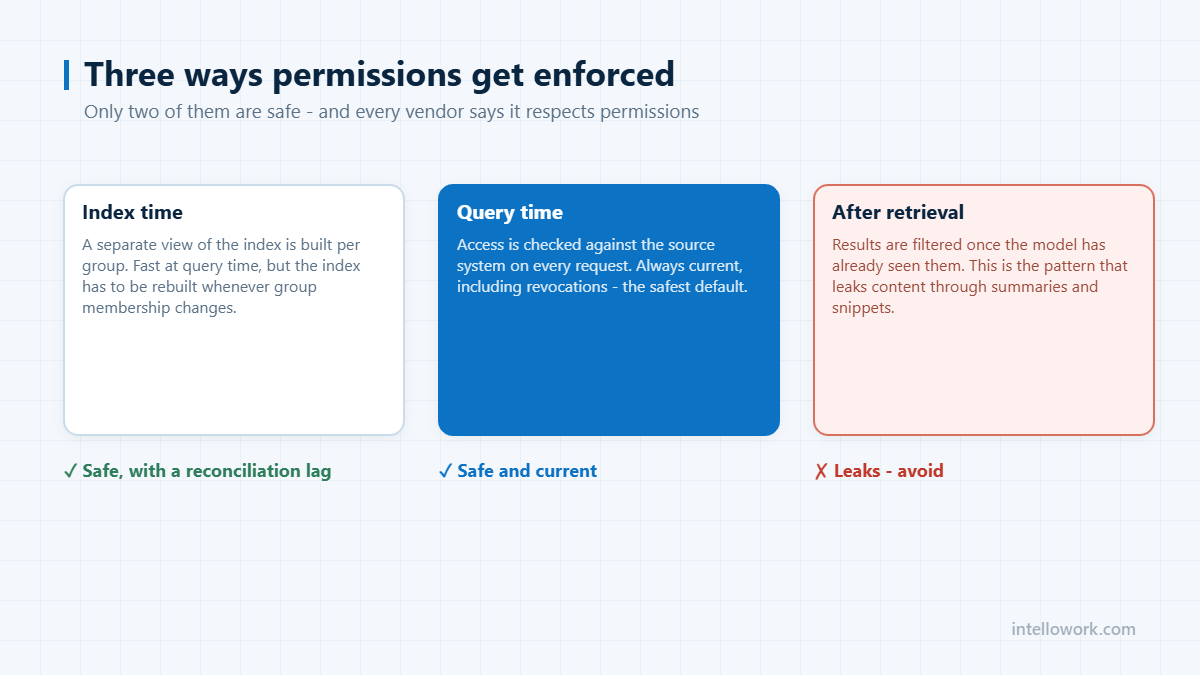
- Query-time permission enforcement. Content restricted to a role, region or entity must be excluded from retrieval when the question is asked – not filtered out after the model has seen it.
- Citations on every answer. A staff member acting on a policy answer needs the clause it came from. Without that, the assistant cannot be used for anything auditable.
- Honest refusal, tuned conservatively. In this sector the cost of a confident wrong answer is asymmetric. Refusal rates should be tested explicitly and set higher than a consumer deployment would tolerate.
- Version-aware content. When a circular supersedes another, the old one has to stop being answerable the same day. Superseded guidance still being retrieved is the most common failure in regulated deployments.
- Full audit trail. Who asked, what was retrieved, what was answered, and when – retained to your own policy and deletable on request.
The wider control set is in enterprise AI chatbot security and compliance, and the mechanics of preventing fabrication in stopping AI chatbot hallucinations.
Data protection and residency
For Indian institutions, the DPDP Act sits alongside sectoral requirements, and the practical consequences for a chatbot are specific: purpose-limited consent captured before the conversation collects personal data, notice at the point of contact, a defined retention period for transcripts, and erasure that reaches the vector index and analytics stores rather than only the primary log. Where the index physically sits, and whether any content reaches a model provider for training, both belong in the contract rather than the sales call.
The detail is in DPDP Act consent rules for AI chatbots. Institutions that need the model and index inside their own boundary should start with private ChatGPT for enterprises.
What to automate, and what to refuse
The line is easier to hold if it is written down before launch.
- Automate: documented policy and product-term retrieval, process and SOP lookups, status and statement queries once identity is verified, and eligibility checks that follow written, server-side rules.
- Automate with confirmation: service requests such as cheque-book issue, address updates or card blocks – identity established, action restated in plain language, executed once, logged.
- Refuse: investment, insurance or credit recommendations; anything requiring suitability judgement; disputes; and hardship or collections conversations. These route to a licensed human, and the assistant should say why.
The design pattern for the middle category – identity, validation, restatement, idempotent execution, audit – is in transactional chatbot flows and campaigns.
Language, which is not a side issue
Customer and frontline-staff questions in India arrive in several languages, often mixed with English product terms and written in Latin script. Systems that translate the query before searching lose exactly the tokens that make retrieval work – product names, scheme names, form numbers. Retrieval in a shared multilingual space keeps them, so a question asked in Hindi still finds the answer in an English circular. See multilingual AI chatbot.
Frequently asked questions
Can an AI chatbot give financial advice to customers?
It should not, and a well-designed deployment refuses to. Product recommendations, suitability judgements and investment guidance are regulated activities that belong with a licensed human. What an assistant can safely do is retrieve documented product terms, eligibility criteria and process steps with a citation, and hand over the moment the question turns into advice.
How do we stop it answering from a superseded circular?
Version awareness in the content layer, not in the prompt. Superseded documents have to be removed from or marked in the index on the day they are replaced, and freshness needs to be part of your test set – edit a document, ask the question it answers, and measure the lag before the answer changes.
Where does our data sit?
That is a contract question, and it should be settled before a pilot. Ask for the region the index and logs live in, written confirmation that content is not used to train any model, the retention period for transcripts, and a deletion guarantee that explicitly covers derived stores such as the vector index and evaluation sets.
Should we start with customers or with staff?
Staff, in almost every case. Internal deployments have a smaller risk surface, a clearer content owner and an immediately measurable payoff in handling time, and they surface the content and permission problems that would otherwise appear in front of customers.
How is this different from the rule-based bot we already have?
A rule-based bot answers what someone anticipated; it fails on phrasing it was not scripted for. A retrieval-based assistant answers from your documents as they are written, handles unanticipated phrasing, cites its source, and refuses when nothing matches – which is what makes it usable for policy content that changes faster than a decision tree can be maintained.
Next step
The useful starting point is a discovery on your own query volume and content, scoped to one internal audience. Request access at intellowork.com, or read the enterprise AI chatbot platform overview.