Private ChatGPT for Enterprises: Why Businesses Need a Secure AI Assistant
Updated 4 September 2026
Artificial Intelligence has become an essential part of modern business operations. Employees now use AI to draft emails, summarize meetings, analyze spreadsheets, generate code, prepare reports, and answer customer queries. While public AI tools have significantly improved productivity, they also introduce a major concern that many organizations underestimate—data security.
When employees copy confidential information into public AI platforms, organizations lose visibility over where that information goes, how it is processed, and whether it could be retained for future model improvements. This creates serious risks for enterprises handling customer information, financial records, intellectual property, legal documents, healthcare data, or proprietary business strategies.
This is why organizations across industries are moving toward a Private ChatGPT for Enterprises—an AI assistant designed specifically for secure business environments.
Instead of relying on consumer AI platforms, enterprises now want AI systems that understand internal company knowledge while maintaining complete control over security, compliance, privacy, and governance.
In this guide, you’ll learn why private enterprise AI is becoming the preferred choice for modern organizations, the risks of public AI tools, and how secure AI assistants enable businesses to innovate without compromising sensitive information.
Why Public AI Isn’t Enough for Enterprise Businesses
Public AI platforms are built for general users. They are incredibly powerful, but they are not designed around enterprise governance requirements.
Consider a few common workplace scenarios:
- An HR executive uploads employee salary data to generate performance summaries.
- A finance team asks AI to analyze quarterly financial reports.
- A legal department shares confidential contracts for review.
- A healthcare provider uploads patient documentation.
- A software engineer pastes proprietary source code into an AI chatbot.
Each of these actions may unintentionally expose highly sensitive business information if proper enterprise controls are not in place.
Although many public AI providers offer business-friendly policies, organizations still need stronger guarantees around:
- Data residency
- Data ownership
- User access control
- Audit logging
- Internal knowledge isolation
- Regulatory compliance
- Model governance
For enterprises, productivity alone isn’t enough. AI must also meet strict security and compliance standards.
The Hidden Risks of Public AI Tools
Many organizations begin using AI informally, with employees adopting whatever tools are easiest to access. Over time, this “shadow AI” usage can introduce significant operational and security risks.
1. Confidential Data Leakage
Employees may unknowingly share:
- Customer information
- Financial reports
- Internal presentations
- Legal agreements
- Product roadmaps
- Source code
- Research documents
Without centralized governance, businesses cannot monitor or control how sensitive information is being used.
2. Compliance Challenges
Industries such as healthcare, finance, legal services, insurance, and government must comply with strict data protection regulations.
Sending regulated information into public AI tools may create compliance concerns related to:
- Privacy regulations
- Industry standards
- Internal governance policies
- Customer contractual obligations
Organizations need AI systems that align with their compliance framework rather than introducing additional risk.
3. Lack of Access Control
Public AI tools typically operate at the individual user level.
Enterprise organizations require much more granular permissions, including:
- Department-based access
- Role-based permissions
- Identity management
- Single Sign-On (SSO)
- Multi-factor authentication
- User lifecycle management
Without enterprise-grade identity controls, sensitive business knowledge becomes harder to protect.
4. No Organizational Knowledge Management
Public AI assistants only know what users provide during conversations.
Enterprise AI should securely connect with internal knowledge sources such as:
- Company documentation
- SOPs
- HR policies
- Product manuals
- Technical documentation
- Knowledge bases
- Internal FAQs
- Training materials
A private enterprise assistant becomes significantly more valuable because it understands the organization’s own information while keeping that knowledge protected.
5. Limited Governance and Visibility
Enterprise leaders need visibility into how AI is being used across the organization.
They often require:
- Usage analytics
- Audit logs
- User activity monitoring
- Permission management
- Model controls
- Policy enforcement
- Administrative dashboards
Without centralized governance, AI adoption becomes difficult to manage at scale.
What Is a Private ChatGPT for Enterprises?
A Private ChatGPT is an enterprise-grade AI assistant deployed within a secure business environment.
Unlike consumer AI platforms, it is built around organizational security, privacy, compliance, and operational control.
A private enterprise AI assistant can securely integrate with:
- Internal documents
- Company databases
- Knowledge repositories
- HR systems
- CRM platforms
- ERP software
- Customer support systems
- Project management tools
- Internal workflows
Employees receive intelligent AI assistance without exposing confidential business information outside approved enterprise boundaries.
Instead of functioning as a general-purpose chatbot, it becomes an intelligent digital coworker that understands the company’s processes, policies, products, and documentation.
Core Features of Enterprise AI Assistants
A secure enterprise AI solution typically includes capabilities such as:
Enterprise Data Security
Business information remains protected through secure infrastructure, controlled environments, and organizational governance policies.
Role-Based Access Control
Different employees access only the information relevant to their responsibilities.
For example:
- HR teams access HR documentation.
- Finance teams access financial policies.
- Legal teams access legal resources.
- IT teams access technical documentation.
This minimizes unnecessary data exposure while improving security.
Private Knowledge Retrieval
Instead of searching the open internet, enterprise AI retrieves answers from trusted internal company knowledge sources.
Employees receive faster, more accurate responses based on organizational documentation.
Secure Document Intelligence
Organizations can securely analyze:
- PDFs
- Contracts
- SOPs
- Policies
- Knowledge articles
- Technical manuals
- Research reports
- Compliance documentation
AI transforms static documents into searchable organizational knowledge without compromising data security.
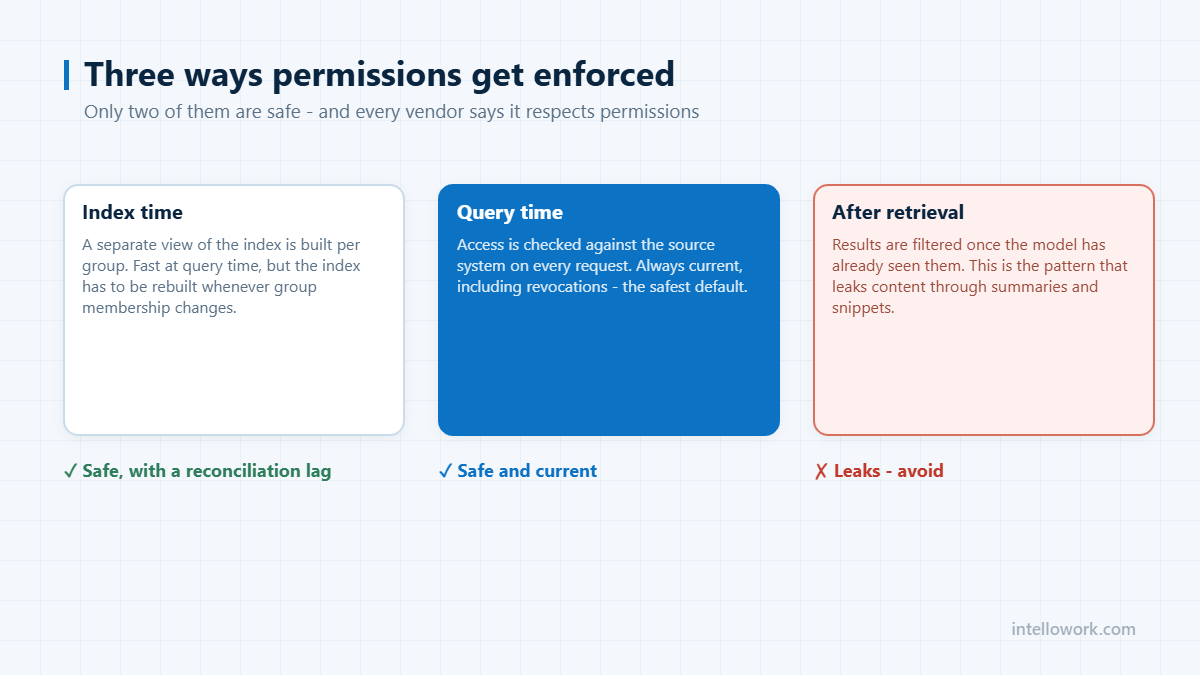
Related: SSO, role mapping, and ACL-aware retrieval.
Frequently asked questions
What is a private ChatGPT for enterprises?
A ChatGPT-style assistant that answers over your company’s own documents and data within a controlled deployment, where content is not sent to a public consumer service and is not used to train anyone’s model. It combines a hosted or managed model with retrieval over your corpus and your access controls.
Is a private deployment more secure than using ChatGPT directly?
It addresses a different risk. The main problem with consumer tools is not the model but governance: uploads bypass your access controls and leave no audit trail. A private deployment restores permission enforcement, logging and retention control, which is what security reviews actually care about.
Do we need to self-host the model?
Usually not. A managed model in a region you selected, under a contract that forbids training on your data, is generally more secure in practice than a self-hosted model your team patches occasionally. Self-hosting makes sense for specific residency, air-gap or latency requirements.
Will our data be used to train the model?
Only if your contract allows it. Get an explicit written commitment covering both the vendor and every subprocessor, including the model provider, and request the subprocessor list. Enterprise tiers and consumer tiers of the same product often differ on this point.
How do we stop employees pasting confidential documents into public AI tools?
Give them a sanctioned alternative that is genuinely faster than the workaround, then enforce policy. Blocking alone tends to push usage onto personal devices, which removes your visibility entirely without removing the behaviour.
Private deployment also removes the main reason people reach for public tools, which we cover in our guide to shadow AI at work.