Best Enterprise AI Chatbot Platforms in 2026: Categories First, Then Names
Updated 1 September 2026
There is no single list of the best enterprise AI chatbot platforms, because the products in that phrase are not competing for the same job. A customer-support deflection engine, a visual bot builder and a knowledge-grounded answer platform will all appear in the same search result and the same analyst grid, and picking between them on a feature matrix is how organisations end up with a tool that does something adjacent to what they needed.
So: categories first, then names. Work out which of the four categories your problem lives in, and the shortlist writes itself.
The four categories
| Category | Primary job | Bought by | Success metric |
|---|---|---|---|
| Customer-support AI | Deflect and resolve inbound support contacts | Support and CX leadership | Resolution rate, cost per contact |
| Conversational bot builders | Design deterministic flows across channels | Digital, marketing, contact centre | Containment, completed journeys |
| Knowledge-grounded answer platforms | Answer from your own corpus, with permissions | IT, knowledge management, operations | Answer accuracy, coverage, adoption |
| Model and framework layer | Components to build your own | Engineering | Whatever you decide it is |
Category 1: customer-support AI
These sit on your support desk, read your help centre and past tickets, and try to close conversations before an agent touches them. Intercom Fin, Zendesk AI, Ada, Forethought and Salesforce Agentforce are the names most often shortlisted here, and the category is the most mature of the four.
Strong when your problem is external, high-volume and ticket-shaped, and your help centre is decent. The integration with ticketing, agent handover and CSAT measurement is built rather than assembled, and pricing usually maps to resolutions, which finance understands.
Weak when the questions need internal systems, or when the audience is employees rather than customers. Support AI is architected around a public knowledge base and a ticket object. Point it at a permission-varying internal corpus and you are fighting the product’s assumptions.
The question to ask: what happens when the answer is not in the help centre? A good platform refuses and escalates with context. A weaker one improvises, and you discover it in a screenshot.
Category 2: conversational bot builders
Microsoft Copilot Studio, Google Dialogflow CX, Voiceflow, Botpress, Yellow.ai and Kore.ai belong here. You get a canvas, intents or topics, entities, integrations and multi-channel deployment. Increasingly they also bolt on retrieval, which is why they now show up in the same searches as category three.
Strong when the interaction is a process rather than a question: onboarding a customer, booking a slot, qualifying a lead, running a guided diagnostic. Deterministic flows are exactly right when the path must be identical every time, and these tools are also the natural home for transactional chatbot flows.
Weak when the real requirement is open-ended question answering over a large, changing corpus. The retrieval bolted onto a flow builder is usually a single index with coarse permissions. That is fine for a public FAQ and inadequate for a corpus where different employees may see different things.
The question to ask: how does retrieval respect source-system permissions, and how quickly does a revoked permission take effect?
Category 3: knowledge-grounded answer platforms
Glean, Guru, Dashworks, Microsoft 365 Copilot in its enterprise-search role, and IntelloWork sit in this category. The centre of gravity is the corpus, not the conversation: connectors into the systems where knowledge already lives, permission-aware retrieval, ranking, and an answer layer with citations.
Strong when the problem is that the answer exists somewhere and nobody can find it – the classic internal helpdesk, engineering documentation, policy and process case. This is also the only category that treats access control as a first-class architectural concern rather than a configuration screen.
Weak when you need scripted multi-step transactions or a public marketing-site persona. Answer platforms answer; they are not campaign tools.
The question to ask: show me the retrieval trace for a specific answer, for a specific user, on a specific date. If they cannot, you cannot audit it, and you should read our security and compliance checklist before going further.
Category 4: the model and framework layer
Foundation model providers, vector databases, orchestration frameworks and reranking services. Not a chatbot platform at all, but frequently compared against one because a proof of concept is fast to assemble.
Strong when retrieval is core to your own product, or when a residency or air-gap constraint rules out vendors, and you have a platform team that will own it for years. Weak when the business case assumes the demo represented most of the work. It represented the easy part; connectors, permissions, incremental indexing, evaluation and monitoring are the rest.
How to actually decide
Three questions, in this order, resolve most shortlists.
- Who is asking – customers or employees? External and ticket-shaped points to category one. Internal points to category three, almost always, because permissions dominate everything else.
- Is it a question or a process? Open-ended questions over a changing corpus point to category three. A path that must be identical every time points to category two.
- Where does the answer live? If it lives in one tidy help centre, most tools will cope. If it is spread across a wiki, a drive, a ticket system and three SaaS products with different permission models, connector quality is the whole decision.
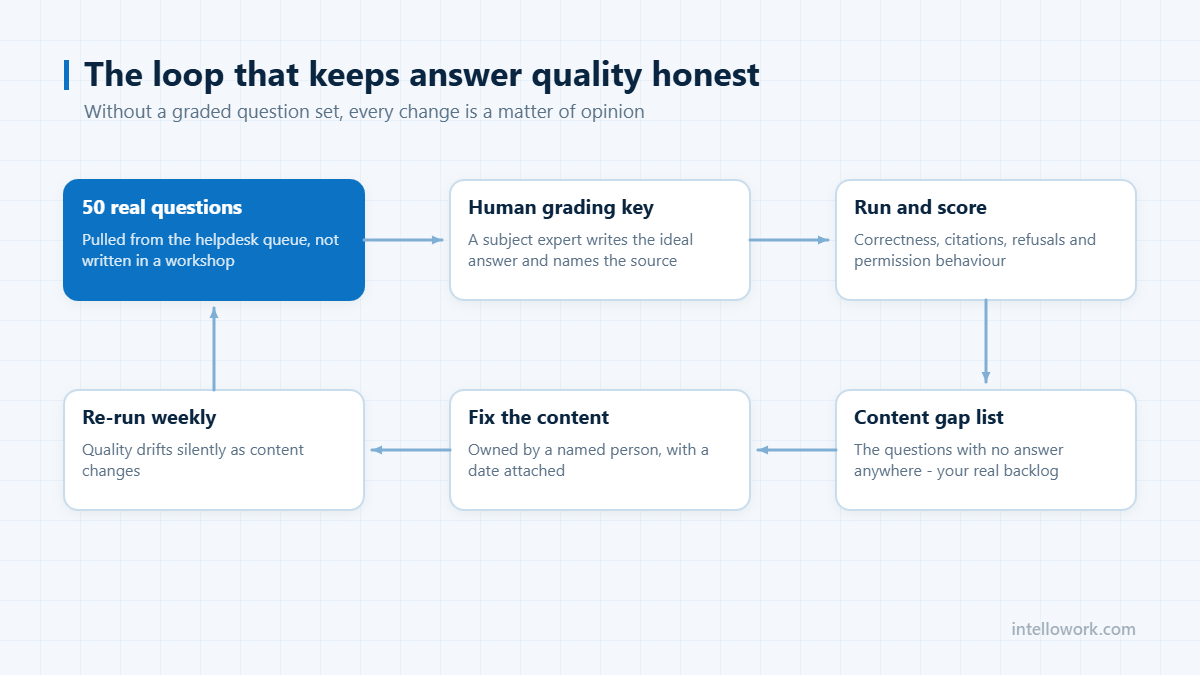
Then run the same test on every shortlisted vendor. Build 50 real questions from your own tickets or search logs, with hand-written correct answers and their sources. Make each vendor run them against your content, not a demo corpus, and score correct-and-cited. It converts a procurement exercise into a measurement, and it is the single highest-return week in the whole process. The mechanics are in how to run a 30-day pilot.
Evaluation criteria that predict success
| Criterion | What good looks like |
|---|---|
| Connector depth | Native connectors that read source ACLs, with incremental sync |
| Permission enforcement | Applied at retrieval time, not after generation |
| Refusal behaviour | Says it does not know, names what it searched, escalates |
| Citation granularity | Claim-level, deep-linked, with document version or date |
| Evaluation tooling | Golden sets, groundedness scoring, regression runs |
| Auditability | Full retrieval trace retrievable months later |
| Multilingual retrieval | Shared vector space, not translate-search-translate |
| Channels | One retrieval layer behind web, Slack and Teams |
Notice how little of that is about the model. Model choice is the most discussed and least decisive variable in an enterprise deployment, for the reasons set out in our piece on stopping hallucinations.
Frequently asked questions
What is the best enterprise AI chatbot platform?
There is no single best platform because the category contains four different product types. Customer-support AI suits external ticket deflection, bot builders suit deterministic multi-step processes, knowledge-grounded answer platforms suit internal question answering over permission-varying content, and the framework layer suits teams building their own. Identify the category first, then shortlist within it.
How is an answer platform different from a support chatbot?
A support chatbot is organised around a ticket and a public help centre, optimising for deflection. An answer platform is organised around a corpus, with connectors into multiple internal systems and permission-aware retrieval, optimising for accurate, cited answers to whoever is entitled to see the underlying content.
Can one platform serve both customers and employees?
Sometimes, but the requirements diverge sharply. External deployments prioritise brand voice, escalation to agents and CSAT; internal deployments prioritise permission enforcement, connector breadth and auditability. Many organisations run one platform per audience rather than compromising both.
How do we compare vendors fairly?
Build 50 real questions from your own tickets or search logs with hand-written correct answers and sources, then make every vendor run them against your own content rather than a demo corpus. Score correct-and-cited, plus behaviour on questions your content genuinely cannot answer.
Does the underlying model matter when choosing?
Less than most buyers expect. Retrieval quality, connector depth and permission enforcement dominate outcomes; if the correct passage never reaches the model, model capability is irrelevant. Treat model choice as a secondary criterion, and ask instead whether you can change models later.
Next step
Decide your category before you book demos. If it is category three, IntelloWork belongs on the list, and the fastest way to test us against anyone else is the 50-question set described above. Pricing across the categories is broken down in enterprise chatbot pricing.