
How to Choose Enterprise Search Tools for Internal Knowledge Discovery
Updated 14 October 2026
Choosing enterprise search tools is unusually hard to do well, because every product demos beautifully. The demo runs on a small, clean, curated corpus with no permission complexity, and it answers questions the vendor selected. Your environment is a decade of accumulated documents across six systems with inconsistent access rules, and the questions come from people who do not know what the documents are called.
So the selection method matters more than the criteria list. What follows is the method, then the criteria that actually predict success, then the questions that make vendors uncomfortable in a useful way.
The method: test on your content, with your questions
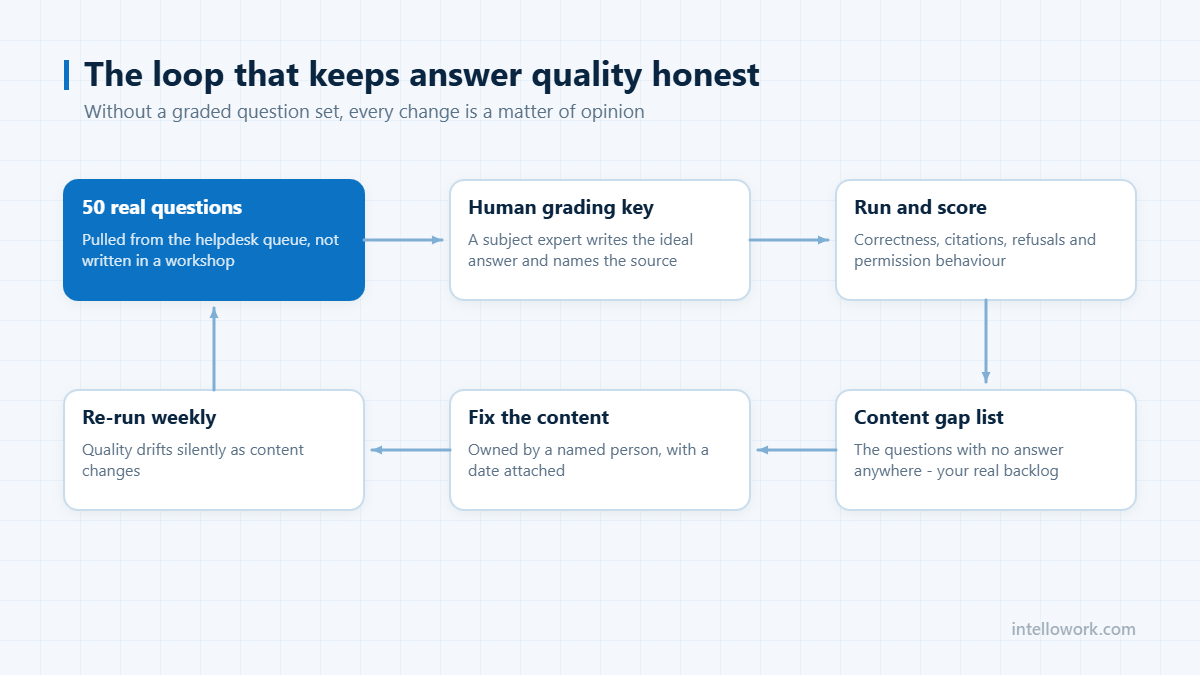
Before you shortlist, build the test. Pull fifty real questions from your ticket queue, your intranet search logs or a survey of the team who will use it. For each, write the correct answer by hand and note which document it lives in. Then add twenty questions your content genuinely cannot answer.
Insist that every vendor runs this set against a sample of your own content, not their demo corpus. Score three things: whether the correct source was retrieved at all, whether the answer was correct and cited, and whether the unanswerable twenty produced honest refusals rather than plausible inventions. That week of preparation converts a procurement exercise into a measurement, and it is the highest-return work in the entire project.
Vendors who resist testing on your content are telling you something. It is reasonable for them to want a scoped subset and a few days to connect it. It is not reasonable to be offered only a curated demo.
Criteria that predict success
| Criterion | What good looks like | Why it predicts outcomes |
|---|---|---|
| Connector depth | Reads source ACLs, incremental sync, handles deletes | Determines whether permissions survive ingestion |
| Permission timing | Filter applied before candidate selection | Post-generation filtering leaks by paraphrase |
| Retrieval quality | Hybrid keyword plus vector, with reranking | Pure vector search fails on identifiers |
| Refusal behaviour | Says it does not know, names what it searched | The single best proxy for trustworthiness |
| Citation granularity | Claim-level, deep-linked, shows document date | Lets users verify rather than trust blindly |
| Auditability | Retrieval trace retrievable months later | Required for incident response and audit |
| Freshness | Minutes to hours from edit to index | Stale answers destroy adoption quickly |
| Multilingual retrieval | Shared vector space, cross-lingual reranking | Matters more than most buyers expect |
Notice that model choice is not on the list. It is the most discussed and least decisive variable, for the reasons set out in stopping hallucinations: if the correct passage never reaches the model, the model is irrelevant.
The demos that mislead
The clean corpus. A few hundred well-written, non-conflicting documents. Your corpus has four versions of the same policy and nobody knows which governs. Ask what happens when sources conflict; the answer should be that both are surfaced with an explicit precedence rule, never silently blended.
The permissionless demo. Everything visible to everyone. Ask them to demonstrate two users with different entitlements asking the same question, and to show what the restricted user gets. It should be nothing – not a hedge, not a paraphrase.
The answerable question. Every demo question has a good answer in the corpus. The important behaviour is what happens when one does not. Bring your own unanswerable question to every demo and watch carefully.
Questions worth asking out loud
- When a user loses access to a space, how long until they stop getting answers from it?
- Show me the full retrieval trace for one answer given last week.
- What happens to the index when a source document is deleted?
- Which of the connectors I need are in the tier you have quoted?
- What does the total cost look like at three times my current volume?
- How do we evaluate quality ourselves after you leave the room?
Question three catches a genuine retention problem: if deleting a document leaves its text answerable, you have an erasure issue that will surface in audit. Question six matters because vendor-run evaluations end at go-live and your quality problems begin there. Cost modelling is broken down in enterprise chatbot pricing.
A scoring sheet you can actually use
Scoring turns a debate about impressions into a decision you can defend. Weight the rows for your situation, but keep the weights fixed before the first demo – adjusting them afterwards is how a preferred vendor wins on paper.
| Criterion | Weight | How to score it |
|---|---|---|
| Answer correctness on your 50 questions | 30% | Graded against a human-written key, by someone who knows the subject |
| Citation accuracy | 15% | Open the cited source. Does it actually contain the claim? |
| Permission enforcement | 15% | Restricted document, unauthorised user, nothing leaks – including titles and snippets |
| Refusal behaviour | 10% | Ten questions with no answer in the corpus. Count confident fabrications |
| Connector depth for your systems | 15% | Not “supports Confluence” but: spaces, restrictions, attachments, page history |
| Freshness and reindex lag | 10% | Edit a document, time how long until the answer changes |
| Admin and analytics | 5% | Can a non-engineer see what failed last week and why? |
Cost deliberately sits outside the score. Price the shortlist after the quality ranking exists, so that a cheap tool that cannot answer your questions does not win on a spreadsheet.
Non-negotiables to settle before procurement
These are the questions that are expensive to answer late, when a contract is signed and a rollout date is public.
- Where does the data sit, and does that satisfy your residency obligations? For Indian entities the retention and erasure requirements are specific – see DPDP Act consent rules for AI chatbots.
- Is your content used to train anyone’s model? Get the answer in the contract, not the sales call.
- How are permissions revoked, and with what lag after a change in the source system?
- What happens to the index if you leave? Deletion timeline, proof of deletion, and export of anything you built.
- Who owns answer quality after go-live, on your side and theirs, and what is the review cadence?
Build, buy, or extend what you already own
Three routes, and most teams choose before they compare them properly.
- Extend the suite you own. Cheapest to start if your content genuinely lives in one ecosystem. Coverage stops where the vendor’s ecosystem stops, and that boundary is usually where the hard questions are.
- Buy a platform. Fastest route to multi-source answers with permissions handled. You are buying connector maintenance more than you are buying a model, which is the part that quietly consumes engineering time when built in-house.
- Build on retrieval infrastructure. Right when search is part of your product, or when a requirement genuinely has no vendor answer. Budget for the unglamorous parts: connectors, permission sync, evaluation harness, and someone who owns them next year.
The honest test for building: can you name the person who will maintain the Confluence connector in eighteen months? If not, buy. The category-level map of what is available is in top enterprise knowledge search tools.
Frequently asked questions
Which enterprise search tools can index HR databases and LMS content?
Treat this as a connector question rather than a product question. Platforms reach an HRMS or an LMS in one of three ways: a packaged connector, a generic REST or JSON connector pointed at the system’s own API, or a scheduled export into a document store. The first is fastest and the rarest. The third is common, and it leaves answers a day stale. Ask each vendor which of the three they are proposing for your HRMS and your LMS by name and version, and ask what happens to records the system exposes only to the record’s owner, such as a payroll row or a performance note. An HR source is where permission handling stops being theoretical.
Can enterprise search index an HRMS without exposing salary or performance data?
Only if entitlements are enforced when documents are retrieved, rather than filtered after an answer has been drafted. The test is cheap to run during evaluation: give two accounts different entitlements, ask both the same question about a restricted record, and check that the unentitled account gets a refusal instead of an answer that merely looks redacted. Run it on your own data. A demo with permissions switched off tells you nothing about this.
Does enterprise search work with LMS course content and completion records?
Course content and completion records behave differently and should be scoped as two requirements. Course material is ordinary document content and indexes like any other library. Completion records are per-person rows in a system of record, so they need a live lookup and the same entitlement checks as any other HR data. A platform can handle the first well and not do the second at all.
Which systems should we connect first?
The two or three that answer the questions people actually ask, not the ones that are easiest to connect. Count a month of helpdesk or HR queries, group them, and see which systems hold the answers. Connecting six sources before you know that is how an evaluation stalls.
How do we evaluate enterprise search tools fairly?
Build fifty real questions with hand-written correct answers and sources, plus twenty your content cannot answer, and require every vendor to run them against a sample of your own content. Score retrieval recall, correct-and-cited answers, and honest refusal on the unanswerable set.
What matters most when choosing?
Connector depth and permission handling, then retrieval quality and refusal behaviour, then citation granularity and auditability. The underlying model matters far less than buyers expect, because retrieval recall sets a hard ceiling on accuracy regardless of model capability.
What should we watch out for in vendor demos?
Curated corpora with no conflicting documents, demos with permissions switched off, and question sets where every question has a good answer. Bring your own conflicting documents, your own two users with different entitlements, and your own unanswerable question.
How long should an enterprise search evaluation take?
Two to four weeks of real testing is enough to separate a shortlist of three, provided the question set and the grading key exist before the first demo. Longer evaluations rarely produce better decisions; they produce more demos. What does justify more time is a proof of concept on your own content with your own permission model, which is a different exercise from a vendor-run trial.
Should we involve procurement and security early or late?
Early, but with a narrow question. Ask security to define the non-negotiables – data residency, training use, deletion, permission enforcement – before the shortlist, so vendors that cannot meet them never enter the evaluation. Bringing them in after a favourite has emerged turns a technical review into a negotiation.
Is it better to build enterprise search in-house?
Only when search is part of what you sell, or when a hard requirement has no vendor answer. The model layer is the commoditised part. The durable cost is connectors, permission synchronisation and an evaluation harness that keeps working as content changes – and that cost recurs every year, not once.
Next step
Build the question set first. Then run it against your shortlist, IntelloWork included. Category context is in enterprise knowledge search tools.
If SharePoint is your largest source, our guide to AI search for SharePoint lists the four failure modes worth testing in any demo.