How AI Reduces Knowledge Silos in Modern Enterprises
Updated 1 September 2026
Introduction
Every business generates valuable knowledge every single day. Employees create project documentation, customer insights, sales proposals, HR policies, technical guides, meeting notes, and operational processes that help the organization function efficiently. Over time, this information becomes one of the company’s greatest assets.
However, there is one major problem.
Most organizations don’t struggle with creating knowledge—they struggle with finding and sharing it.
Business information is often scattered across multiple applications, departments, and cloud platforms. Marketing stores campaign assets in Google Drive, HR manages policies in SharePoint, Sales keeps customer information inside CRM software, while IT documents procedures in Confluence or Jira. Each team works efficiently within its own environment, but accessing information across departments becomes increasingly difficult.
These disconnected repositories create what businesses call knowledge silos.
Knowledge silos slow down collaboration, increase duplicate work, delay decision-making, and reduce overall productivity. Employees spend valuable time searching for answers instead of focusing on meaningful work.
Fortunately, Artificial Intelligence is changing how organizations manage and access information. AI-powered enterprise search and knowledge management platforms now enable businesses to break down knowledge silos, connect information across systems, and provide employees with instant access to trusted organizational knowledge.
In this article, we’ll explore what knowledge silos are, why they hurt business performance, and how AI helps modern enterprises build a smarter, more connected workplace.
What Are Knowledge Silos?
Knowledge silos occur when valuable business information is isolated within individual departments, software platforms, or teams, making it difficult for others in the organization to access.
Instead of knowledge being shared across the company, it remains locked inside specific systems or with specific individuals.
For example:
- Human Resources stores employee policies in SharePoint.
- Sales manages customer proposals inside the CRM.
- Marketing maintains campaign assets in Google Drive.
- IT documents troubleshooting procedures in Confluence.
- Operations keeps Standard Operating Procedures (SOPs) in another internal system.
Each department has access to its own information, but employees outside that department often struggle to find what they need.
As organizations grow and adopt more software, these silos become larger and more difficult to manage.
Why Knowledge Silos Are a Serious Business Problem
Many organizations underestimate the cost of inaccessible knowledge.
When employees cannot easily find information, productivity suffers across every department.
Employees Spend More Time Searching
Instead of completing important work, employees search through multiple applications, emails, shared drives, and chat conversations to locate documents or answers.
Even small delays become significant when multiplied across hundreds of employees.
Duplicate Work Increases
When teams cannot find existing documents or processes, they often recreate them.
This leads to duplicate proposals, duplicated research, inconsistent documentation, and unnecessary operational costs.
Collaboration Becomes Slower
Departments often work independently because they cannot easily access information created by other teams.
This creates communication gaps and slows down cross-functional projects.
New Employee Onboarding Takes Longer
New employees need quick access to company knowledge.
Without a centralized knowledge experience, onboarding becomes slower and requires more support from managers and HR teams.
Business Decisions Become Less Reliable
Decision-makers rely on accurate information.
When knowledge is fragmented or outdated, leaders may make decisions based on incomplete data, increasing business risk.
Why Traditional Knowledge Management Is No Longer Enough
Traditional knowledge management systems were designed primarily for storing documents—not helping employees find answers quickly.
Most organizations still rely on folder structures, keyword searches, and multiple disconnected applications.
Although these systems successfully store information, they often fail to make that information easily accessible.
Traditional search also depends heavily on exact keyword matching.
For example, if an employee searches for “Remote Work Policy” but the document is titled “Hybrid Workplace Guidelines,” traditional search may not return the correct result.
Employees either continue searching manually or ask colleagues for help.
As organizations continue to adopt new digital tools, these limitations become even more noticeable.
Businesses need a smarter way to access organizational knowledge.
How AI Breaks Down Knowledge Silos
Artificial Intelligence introduces an entirely new approach to knowledge management.
Instead of forcing employees to remember where information is stored, AI connects multiple systems and allows users to search naturally.
Unified Enterprise Search
AI-powered enterprise search creates a single search experience across all connected business applications.
Employees no longer need to remember whether a document is stored in Google Drive, SharePoint, Notion, Slack, or another platform.
One search retrieves relevant information from every connected source they have permission to access.
This dramatically reduces search time while improving employee productivity.
Natural Language Understanding
Unlike traditional search, AI understands how people naturally ask questions.
Employees can simply type:
- Where is the latest HR policy?
- Show me our employee onboarding process.
- Find the Q2 sales presentation.
- What is our reimbursement policy?
The system understands intent rather than relying solely on exact keywords.
This creates a much more intuitive search experience.
Semantic Search Improves Accuracy
Modern AI platforms use semantic search to understand relationships between concepts.
Even if documents use different terminology, AI recognizes the intended meaning and returns the most relevant results.
This significantly improves search accuracy compared to traditional keyword-based systems.
Retrieval-Augmented Generation (RAG)
One of the biggest innovations in enterprise AI is Retrieval-Augmented Generation (RAG).
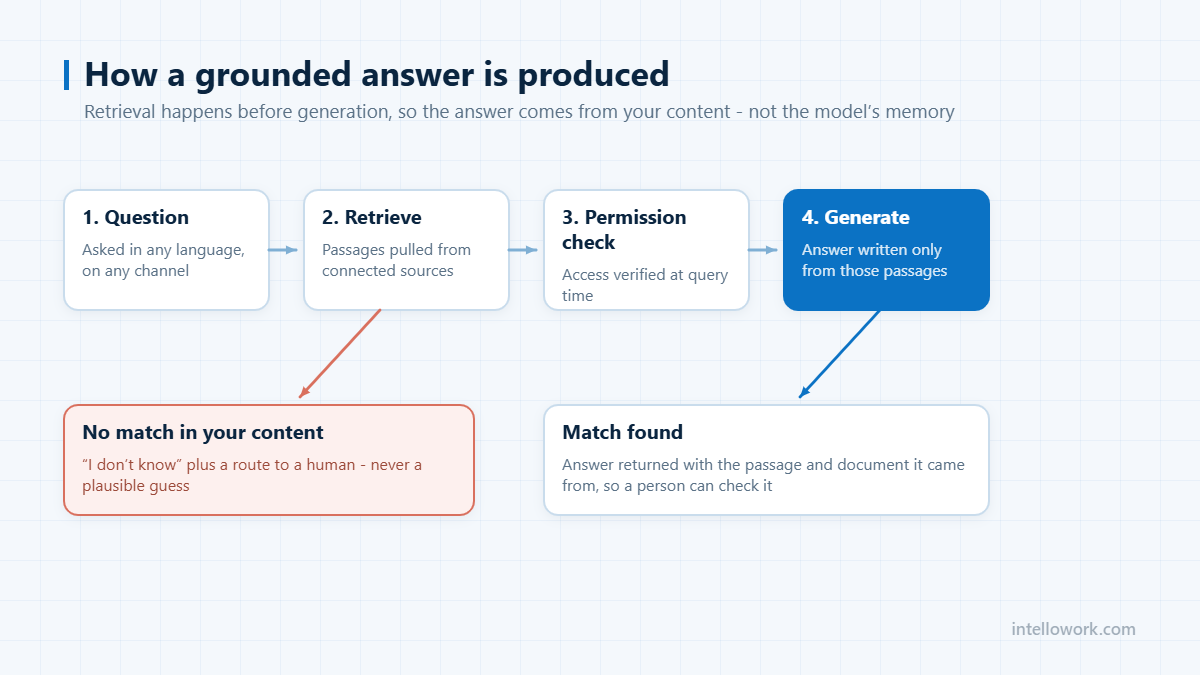
Instead of generating generic answers from public internet knowledge, RAG first retrieves trusted information from internal company systems before generating a response.
This ensures employees receive accurate, context-aware, and organization-specific answers based on the latest available information.
For enterprises, this means greater trust, better compliance, and more reliable decision-making.
How do AI search assistants help in reducing knowledge silos?
By searching across every connected source at once — wikis, drives, indexes, internal APIs — and answering with citations, an AI search assistant makes the silo boundaries invisible to the person asking. The knowledge stays where it lives; the answer travels. Permissions still apply per source, so breaking down silos never means breaking down access control.
Frequently asked questions
What are knowledge silos?
Knowledge silos are pockets of information held in one team, system or person’s head that other parts of the organisation cannot reach. They form naturally as teams adopt their own tools and conventions, and they are usually invisible until someone spends a day rediscovering something a colleague documented two years ago.
How does AI reduce knowledge silos?
By indexing content across the systems where it already lives and answering questions from all of them at once, subject to each asker’s permissions. The silo is not removed – the wiki, the drive and the ticket system all still exist – but the boundary between them stops mattering at the moment someone needs an answer.
Does breaking down silos mean everyone sees everything?
No, and it must not. Access control has to be enforced at retrieval time so that content someone is not entitled to see is never a candidate for their answer. Done properly, an assistant respects existing permissions more consistently than people sharing files by email do.
What is the first step to reducing knowledge silos?
Find where the same question is being answered repeatedly across different teams, and check whether the answer already exists in writing somewhere. That tells you whether you have a findability problem, which retrieval solves, or a documentation problem, which it does not.
How do we measure progress?
Track the questions people ask that no document answers, ranked by frequency, and work that list weekly. Falling repeat-question volume and rising answer coverage are more meaningful than any survey of whether people feel better informed.