
AI Chatbot Development Company in India
Updated 1 September 2026
IntelloWork is built by Exuverse, an AI product company based in Noida, India. We build and deploy enterprise AI chatbots – grounded in a client’s own content, permission-aware, and measured after launch rather than demoed and handed over.
This page sets out what an AI chatbot development engagement involves, how to tell a product team from a body shop, and what to ask before you sign anything.
Build, buy, or a bit of both
Most enterprises asking for “chatbot development” do not need a chatbot built from scratch. The model layer is commoditised; the durable work is connectors, permission mapping and evaluation. Three honest routes:
- Deploy a platform, configured to you. Fastest and usually correct. The engagement is integration, content and evaluation work on top of an existing retrieval platform.
- Platform plus custom flows. The right shape when transactional actions – bookings, ticket creation, record updates – have to run against systems that have no ready connector.
- Fully custom build. Justified when conversational search is part of the product you sell, not an internal tool. Budget for maintaining connectors and an evaluation harness every year, not once.
A development partner who cannot talk you out of the third option when the first would do is selling hours, not outcomes. The trade-offs are worked through in how to choose enterprise search tools.
What a real engagement looks like
| Phase | Work | What you should receive |
|---|---|---|
| Discovery | Ticket and query analysis, source inventory, access model review | A ranked list of use cases with volumes attached, not a proposal deck |
| Evaluation set | 50 real questions with human-written ideal answers | A written grading key you own and can reuse against any vendor |
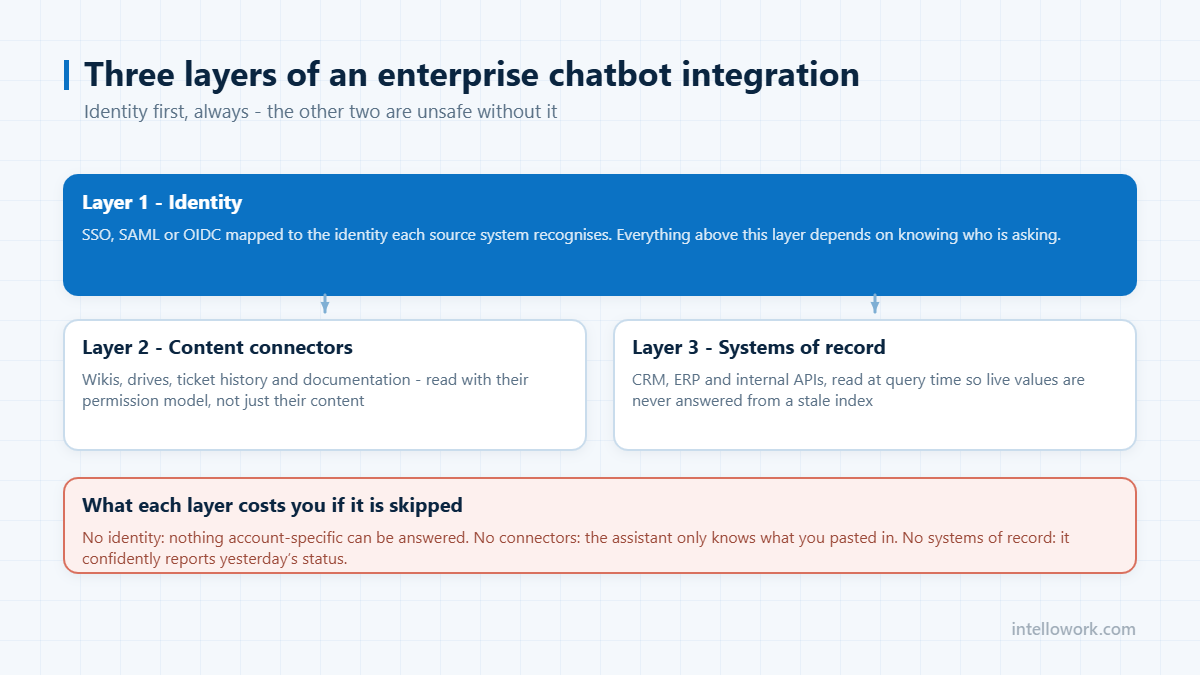
| Integration | Connectors, identity mapping, permission enforcement | A tested access model, including a restricted-document test |
| Tuning | Retrieval configuration, chunking, refusal thresholds | A graded score against your question set, plus the content gap list |
| Pilot | 20-50 real users, instrumented | Weekly deflection, escalation and correctness numbers |
| Handover | Runbooks, admin training, monitoring routine | Named owners on your side and a review cadence that outlives the project |
Note where the effort sits. In most engagements the content and permission work is larger than the software work, and any partner who prices as though it is not will discover it in month two.
How to qualify a development partner
The market is crowded and the pitches converge. These questions separate them:
- How do you enforce permissions? Listen for query-time enforcement against the source system. “We filter results afterwards” is the pattern that leaks content through summaries.
- Show me a refusal. Ask for a live demo of the assistant declining a question with no answer in the corpus. Teams that have never optimised for this will not have one ready.
- What is your evaluation method? If the answer is not a graded question set, quality is being assessed by vibes and will drift silently after launch.
- Who owns answer quality after go-live? A project that ends at deployment leaves you with an assistant nobody maintains by month three.
- What happens to our data? Where the index sits, whether content is used for training, retention periods, and whether deletion reaches derived stores.
- What does the exit look like? Export of what was built, deletion of the index, and documentation good enough for another team to pick up.
Compliance for Indian deployments
If you are deploying in India, the Digital Personal Data Protection Act shapes the build rather than decorating it. Consent has to be purpose-specific and captured before the conversation collects anything; notice must be visible at the point of contact rather than buried in a policy page; transcripts need a defined retention period; and erasure has to reach the vector index and analytics stores, not only the primary log. Processor terms with any model provider need to say all of this in writing.
The detailed obligations are covered in DPDP Act consent rules for AI chatbots, and the broader control set in enterprise AI chatbot security and compliance.
What we build
- Employee assistants for HR and IT helpdesks, grounded in current policy and runbooks.
- Customer support automation with grounded answers, live account lookups and clean agent handover.
- Enterprise knowledge search across wikis, drives and ticket history, with permissions enforced per answer.
- Transactional flows – bookings, ticket creation, record updates – with identity, confirmation and audit.
- Multilingual deployments where questions in one language must find answers in another.
- Channel delivery across web, Slack, Microsoft Teams and WhatsApp from a single retrieval layer.
Frequently asked questions
How much does AI chatbot development cost in India?
Cost is driven by scope rather than by a rate card: the number of systems to connect, how complex the access model is, whether the assistant only answers or also writes to your systems, and how much content clean-up is needed first. A scoped single-department deployment is a very different number from a multi-system rollout with transactional flows. Any figure quoted before a source inventory and a ticket analysis is a guess – ask for the discovery first.
How long does it take to build an enterprise AI chatbot?
Four to six weeks to a scoped pilot in front of real users is realistic when the content exists and access can be granted promptly. Connecting sources takes days; permission mapping, content clean-up and getting answer quality to a trusted level take the rest. Programmes that run longer usually stalled on access approvals or on content that was never written down.
Do we need our own model, or is fine-tuning required?
Almost never. The problems most enterprises have are retrieval problems – the answer exists somewhere and the system cannot find it, or is not allowed to. Retrieval-augmented generation solves that without training and updates the moment a document changes. Fine-tuning is worth discussing only when tone or output format, rather than knowledge, is the gap. See retrieval-augmented generation (RAG).
Can the chatbot be deployed in our own environment?
Deployment can be scoped so that content, embeddings and logs stay within a region or an environment you control. Ask any partner to put the specifics in the contract – where the index lives, whether content is used for training, retention periods, and a deletion guarantee that covers derived stores.
What happens after the project ends?
Answer quality degrades if nobody owns it, so handover should include a monitoring routine, named owners on your side and a review cadence – not just credentials and a runbook. The weekly review that keeps quality honest is described in monitoring internal AI assistants.
Talk to the team
If you have a use case and a source system in mind, the useful first conversation is a discovery on your own tickets and content rather than a demo. Request access at intellowork.com, or read the enterprise AI chatbot platform overview first.