
How to Make Your Business AI-Enabled: A Practical Roadmap
Updated 1 September 2026
Becoming an AI-enabled business is less about adopting AI than about fixing the conditions that make AI useful. Almost every stalled programme stalls for the same three reasons: the knowledge was never written down, the permissions were never modelled, and nobody owned the outcome. None of those is an AI problem, and none of them is solved by choosing a different model.
Here is a roadmap that front-loads the parts that actually determine success.
Phase 1: find where the repeated work is
Do not start from capability – start from repetition. Pull the ticket queues, the shared inboxes, the intranet search logs. What question gets asked ten thousand times a year? What task does someone do the same way every Tuesday? Repetition plus written-down answers is where AI pays back fastest, and it is measurable, which matters more than it sounds.
Record the baseline while you are there: volume by category, median handling time, fully loaded cost. Skipping this is the most common reason a successful pilot cannot be defended at renewal – you will be arguing from anecdote against a spreadsheet.
Phase 2: audit the knowledge, honestly
For each candidate, ask one question: does the answer exist in writing or in a system today? If yes, retrieval can surface it. If it lives in three people’s heads, no AI programme will extract it, and the useful project is a documentation project that happens to make an assistant possible afterwards.
This audit reliably produces an uncomfortable finding: the organisation knows less in writing than it believed. That finding is worth having on its own, independent of any AI decision.
Phase 3: model permissions before you index anything
Who may see what is an architecture decision, not a configuration screen. Write down the scopes – public, customer, employee, manager, privileged – and map every content source to them. Then require that access control is enforced at retrieval time, so restricted passages never enter a model’s context. Doing this after launch means reindexing and, usually, an incident first. Detail in enterprise chatbot integrations.
Phase 4: one use case, measured properly
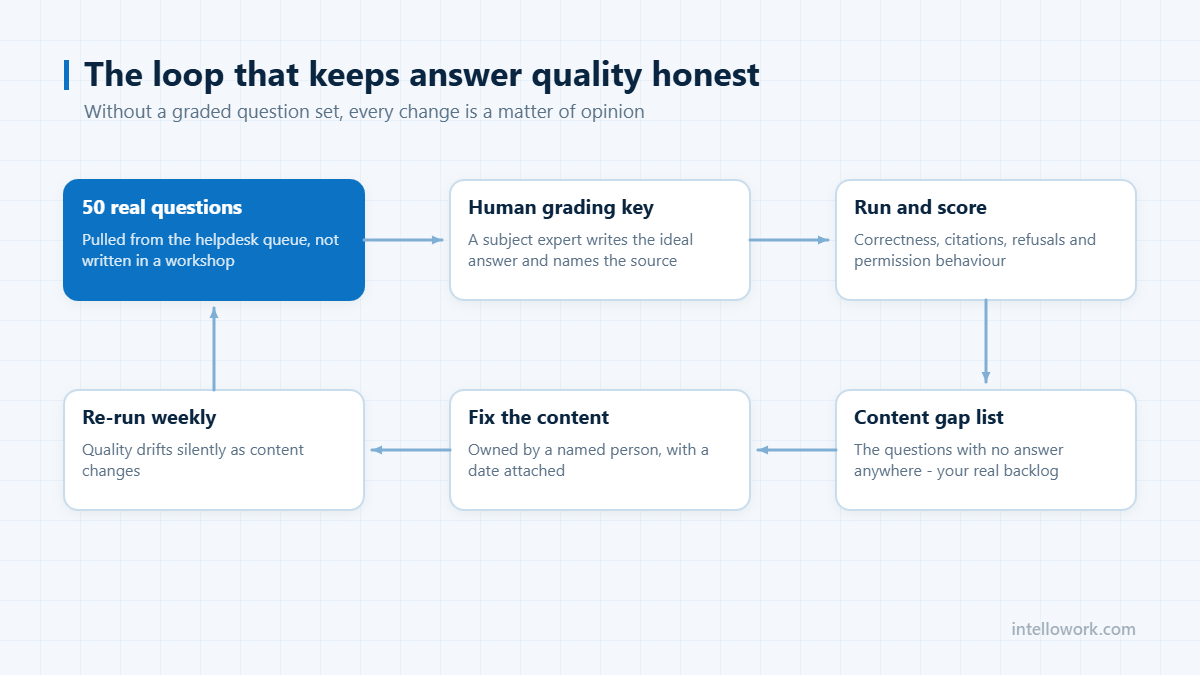
Pick the candidate with the highest ratio of question volume to content chaos. Build a fifty-question evaluation set with hand-written correct answers and sources, plus twenty questions your content cannot answer. Launch to one department. Read every conversation for the first fortnight – yes, every one. Then compare against your baseline. The sequence is set out in running a 30-day pilot.
Phase 5: make it somebody’s job
The unglamorous phase that decides everything. Someone must own the content gap list and work it weekly, watch groundedness and refusal rates, and keep source documents current. An assistant without an owner degrades quietly as content ages, and within a year the organisation concludes the technology failed when what actually failed was maintenance.
What to sequence later
| Capability | When | Prerequisite |
|---|---|---|
| Document question answering | First | Content exists, permissions modelled |
| Live system lookups | After 2 to 3 months | Read-only API access, identity flow proven |
| Additional channels | After the first stabilises | Shared retrieval layer, not a second index |
| Multi-step agents | Later still | Trusted read path, action logging, named owner |
| Write actions | Last, one at a time | Explicit confirmation and audit trail |
A 90-day sequence that holds up
The five phases above are the logic. This is the calendar. Ninety days is long enough to put something real in front of users and short enough that the sponsor is still the same person at the end of it.
| Window | Work | Exit condition |
|---|---|---|
| Days 1-15 | Shadow one team. Log every repeated question and request, with volume and handling time. | A ranked list of repeated work, with numbers attached |
| Days 16-30 | Content audit on the top use case only. Find the answers, fix the ones that are wrong, retire the duplicates. | One source of truth per question, owned by a named person |
| Days 31-45 | Permission map. Who may see what, in which system, and how that is enforced at query time. | A written access model, tested with a restricted document |
| Days 46-70 | Build and pilot with 20-50 users. Instrument everything: answered, deflected, escalated, wrong. | A weekly number the sponsor believes |
| Days 71-90 | Fix the top ten failures. Decide expand, hold or stop, on evidence. | A written decision, not a demo |
Notice what is missing: model selection, vendor bake-offs and platform architecture. Those decisions get easier once you know which fifty questions matter, and they get made badly when you take them first. The mechanics of the pilot window are covered in more depth in the guide to how to run an AI chatbot pilot.
What an AI-enabled business actually looks like
Abstract answers here are useless, so here is the concrete version, department by department. None of these is transformational on its own. Together they change how much of the week is spent on work that nobody wanted to do.
- HR answers leave, payroll and policy questions from the current handbook, with the source cited, and escalates anything involving an individual’s case to a human. See AI chatbot for HR.
- IT deflects password, access and device questions at level one, and opens a correctly categorised ticket when it cannot. See AI chatbot for the IT helpdesk.
- Sales gets accurate product and pricing answers out of the same documents the product team maintains, instead of the deck someone saved last quarter.
- Support drafts replies grounded in the knowledge base, with an agent approving before anything is sent.
- Finance and legal get retrieval over contracts and policies with permissions enforced, which is usually the first place a general-purpose assistant becomes unacceptable.
Five ways these programmes fail
The failure modes are boringly consistent across companies and sizes.
- Starting with the technology. A platform is chosen before anyone has written down the questions it must answer, so success has no definition.
- Indexing everything. Broad coverage on day one guarantees that stale, contradictory and confidential content all surface together, and trust is lost in week two.
- No owner. The assistant is launched by a project team that disbands, and nobody is accountable for answer quality by month three.
- Measuring usage instead of outcome. Sessions and messages go up and to the right while ticket volume does not move. Measure deflection, escalation and correctness.
- Punishing refusal. Teams optimise for a confident answer to every question, which is exactly how an assistant loses the trust it needs to be useful.
Frequently asked questions
Where should a business start with AI?
Start from repetition rather than capability. Find the questions and tasks that repeat thousands of times a year and whose answers already exist in writing, record a baseline of volume and handling time, and deploy there first. It produces a measurable result in weeks and buys credibility for harder work.
Why do AI programmes stall?
Three recurring reasons: the knowledge was never written down, so retrieval has nothing to surface; permissions were never modelled, so the deployment is unsafe or over-restricted; and nobody owned the outcome, so quality drifted as content aged. None of the three is solved by changing model.
How do we build the business case?
Capture the baseline before launch: volume by category, median handling time and fully loaded cost per interaction. Afterwards, report true deflection with 48-hour re-contacts subtracted, alongside improvements in handoff quality. A defensible smaller number survives renewal; an inflated one does not.
How much does it cost to become an AI-enabled business?
For a first scoped use case, the licence is rarely the largest number. Budget for three things: platform or per-seat cost, integration work to connect the two or three systems that matter, and content clean-up. In most first-year deployments the content and permission work costs more than the software. Starting narrow keeps all three small enough to justify without a formal programme.
Do we need to train our own model?
Almost certainly not. The problems most businesses have are retrieval problems, not model problems: the answer exists somewhere and the system cannot find it, or is not allowed to. Retrieval-augmented generation over your own content solves that without training, and it updates the moment the document does. Fine-tuning is worth revisiting only when tone or format, not knowledge, is the gap.
What skills do we need in-house?
Fewer than most teams expect, and different ones. You need someone who owns content accuracy, someone who understands the access model in your source systems, and an analyst who will read the failure logs weekly. Deep machine-learning expertise is optional for a retrieval-based deployment; institutional knowledge about where the truth lives is not.
How do we measure return on an AI deployment?
Pick the measure before launch and keep it stable. Deflection rate, handling time on the tickets that still reach a human, time to first answer, and a weekly sample of answers graded for correctness by someone who knows the subject. Usage counts are not outcomes. If the number you report cannot get worse, it is not a measurement.
Next step
Do the knowledge audit before you book a single vendor demo. It costs a week and tells you which use cases are real. IntelloWork handles the retrieval layer once you know what you are pointing it at.