
AI Employees for Business: What They Are, What They Are Not, and What to Deploy First
Updated 1 September 2026
AI employees for business is a marketing term for something real but narrower than the phrase suggests. What is actually being sold is a bundle: an assistant with a persistent scope of work, access to a defined set of systems, and permission to take a limited set of actions without asking each time. Useful. Not a colleague.
What they are
Three properties distinguish an AI employee from a chatbot: a standing remit rather than a per-question interaction, memory of prior work within that remit, and the ability to complete multi-step tasks that touch systems. A support assistant that reads a ticket, checks an order, drafts a reply and routes it for approval is doing the job the phrase describes.
What they are not
- Not accountable. Somebody human owns the outcome. If the output is wrong, that person answers for it, so they need visibility into what it did and why.
- Not a headcount substitute you can bank. Capacity is not the same as a role. Business cases built purely on removing salaries tend to collapse under scrutiny.
- Not self-supervising. Quality drifts as content and systems change. Somebody reviews the work, forever.
- Not a licence to skip permissions. An agent with broad standing access is a much larger blast radius than a chatbot with none.
What to deploy first
Choose a remit that is bounded, high volume, and reversible. Good first candidates, roughly in order:
| Remit | Why it is a good first deployment | Guardrail |
|---|---|---|
| Ticket triage and enrichment | High volume, no irreversible action | Human closes the ticket |
| Draft-and-route replies | Improves speed without ceding the send | Human approves before sending |
| Document summarisation for a workflow | Bounded input, bounded output | Cited, linked to source |
| Data entry from structured inputs | Deterministic, easy to verify | Reconciliation report |
| Meeting and decision capture | Creates documentation you lacked | Owner reviews before publishing |
The pattern is consistent: the agent does the work, a human keeps the last click. That is not a temporary training-wheels arrangement – for anything with external consequences it is the permanent design.
The guardrails that matter
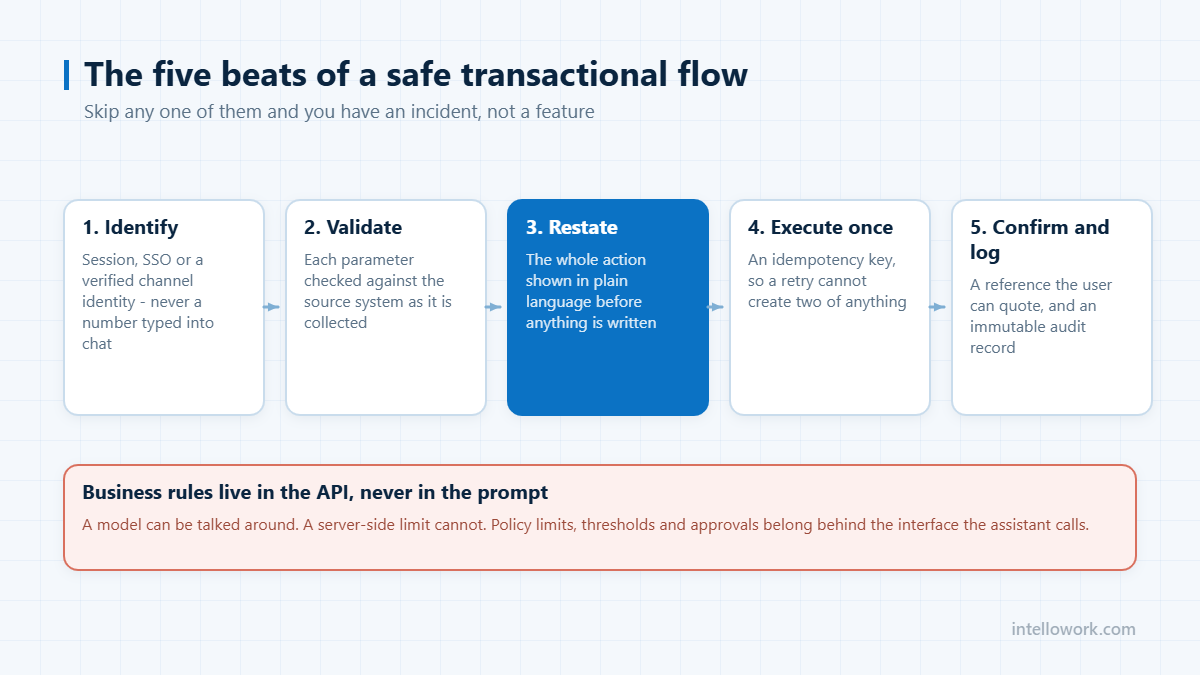
Scope access to the minimum systems the remit requires, and execute as the requesting user rather than a broad service account. Require confirmation for anything with side effects, showing exactly what will happen. Log every action with its inputs and reasoning so it can be reconstructed later. And treat every document the agent reads as untrusted input, because an agent that acts on instructions found inside a retrieved file is the clearest prompt-injection risk in the enterprise – covered in our security checklist.
For the conceptual distinction between agents and assistants, see AI agents vs AI assistants.
The accountability question, asked properly
The most useful exercise before deploying anything with a standing remit is to write down who answers for its output. Not who administers it – who answers for it when a customer, a regulator or an executive asks why it did what it did.
That person needs three things to do the job. They need visibility: a log of what the agent did, with the inputs it used and the sources it read, retrievable months later. They need a brake: the ability to narrow scope or stop the agent without a deployment. And they need a review cadence, because quality drifts as content and systems change underneath it, and drift is invisible unless somebody is looking.
Organisations that skip this step do not discover the gap during normal operation. They discover it during an incident, when nobody can reconstruct what happened and the honest answer to “why did it do that” turns out to be that nobody knows.
Scoping a remit that actually works
A good remit reads like a job description with sharp edges. It states the task, the systems the agent may touch, the actions it may take without asking, the actions that always require confirmation, and what it must never do. If that paragraph is vague, the deployment will be too.
Two failure modes come from bad scoping. The first is a remit so narrow it delivers nothing – an agent permitted only to read and never to draft, summarise or route, which produces no time saving over the existing search box. The second is a remit so broad that its blast radius is unbounded, typically an agent granted a service account with organisation-wide access because scoping per-user permissions looked like too much work at build time. The second failure is far more expensive and far more common than the first.
Between those, aim for a remit where the agent handles a recognisable unit of work end to end – triage this ticket, draft this reply, capture this decision – and a human makes the call that has consequences outside the organisation.
Measuring an agent rather than a chatbot
Chatbot metrics do not transfer cleanly. Deflection is meaningless for an agent that never speaks to an end user, and answer accuracy is only part of the picture when the output is a completed task rather than a sentence.
The metrics that work: task completion rate, meaning the share of assigned work items the agent finished without human intervention; correction rate, the share of completed items a human had to amend before accepting, which is the real quality signal; cycle time against the pre-deployment baseline; and escalation precision, whether the items it declined were genuinely the ones needing judgement. Track correction rate weekly and treat a rise as a regression, because it usually means the content or the upstream system changed rather than that the model got worse.
Frequently asked questions
What is an AI employee?
An assistant with a standing remit rather than a per-question interaction, memory of prior work within that remit, and permission to complete multi-step tasks across defined systems. It is a bundle of capability and scope, not a role, and a human remains accountable for the outcome.
Which AI employee should we deploy first?
Pick a bounded, high-volume, reversible remit: ticket triage and enrichment, drafting replies for human approval, summarising documents inside an existing workflow, or structured data entry with a reconciliation report. Keep the last click with a person.
Do AI employees replace headcount?
They add capacity to specific tasks rather than replacing roles, and business cases built solely on salary removal rarely survive the first year. The more defensible case is throughput, response time and quality of handoffs, measured against a pre-deployment baseline.
What guardrails do AI agents need?
Minimum necessary system access, execution as the requesting user rather than a broad service account, explicit confirmation before any side-effecting action, full action logging for later reconstruction, and treating every retrieved document as untrusted input to defend against prompt injection.
Next step
Write the remit down in one paragraph before you buy anything: what it does, which systems it touches, what it may do without asking, and who reviews the work. If that paragraph is hard to write, the use case is not ready. IntelloWork starts from the retrieval layer that any of this depends on.