Enterprise AI Chatbot ROI: A Model You Can Defend
Updated 4 September 2026
Enterprise AI chatbot ROI is not hard to calculate. However, it is hard to defend. Most business cases collapse in the finance review, because they multiply a large headcount by an optimistic minute count and stop there.
In short, this guide builds a model you can hand to a CFO. It covers where the value actually sits, a worked example for 400 employees, the full run cost, a payback month and the mistakes that inflate every number. For the price side in isolation, see our enterprise chatbot pricing breakdown.
Why most enterprise AI chatbot ROI models fall apart
Typically, three assumptions do the damage, and reviewers spot every one of them.
- Full adoption. Usually the model assumes every employee uses the assistant weekly. In reality, 40 to 60 percent is a strong result in year one.
- Saved minutes become saved money. For example, ten minutes back does not equal ten minutes of billable output. So a haircut is honest, not pessimistic.
- Run cost stops at the licence. Yet model usage, connectors and an internal owner all cost real money.
Fix those three, and then the number gets smaller. However, it also becomes a number that survives scrutiny, which is the only kind worth presenting.
Where enterprise AI chatbot ROI actually comes from
Broadly, four pools of recovered time feed the benefit line. Treat them separately, because each one carries a different level of confidence.
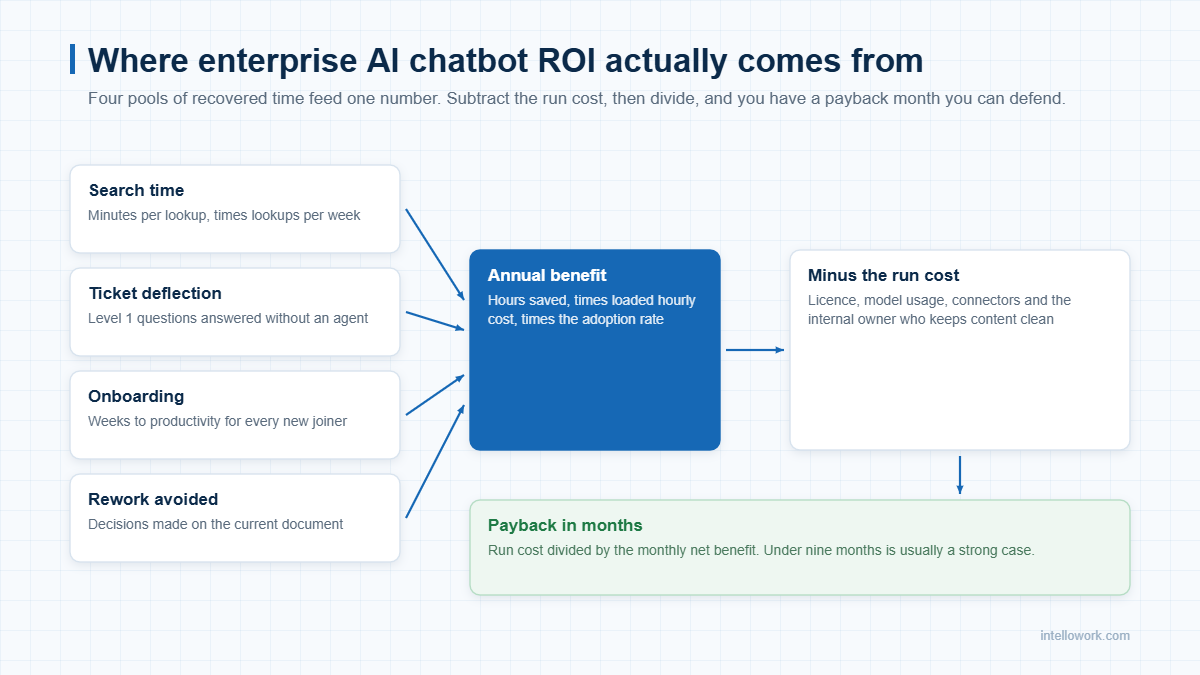
| Value pool | How you measure it | Confidence |
|---|---|---|
| Search time | Lookups per week, times minutes per lookup | High, since logs show it |
| Ticket deflection | Level 1 tickets closed without an agent | High, and easy to audit |
| Onboarding | Days to first independent task for new joiners | Medium, though clearly visible |
| Rework avoided | Decisions taken on the current document version | Low, so keep it out of the headline |
So put the first two pools in the business case. Then mention the other two as upside, rather than as commitments.
A worked enterprise AI chatbot ROI model for 400 employees
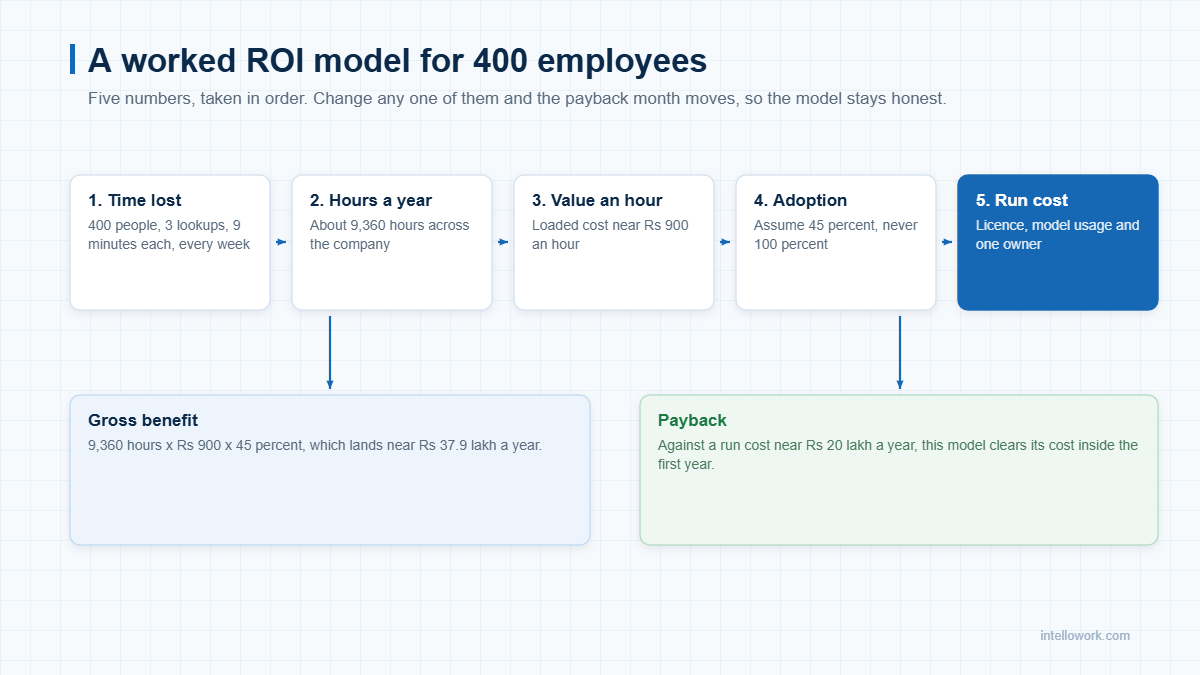
Below is the arithmetic in full, and above all it stays simple. Moreover, every input is a number your own team can challenge.
| Step | Input | Result |
|---|---|---|
| 1 | 400 employees, 3 lookups a week, 9 minutes each | 180 hours a week |
| 2 | Across 52 weeks | About 9,360 hours a year |
| 3 | Loaded cost of Rs 900 an hour | Rs 84.2 lakh of time |
| 4 | Adoption of 45 percent | Rs 37.9 lakh gross benefit |
| 5 | Less run cost of Rs 20 lakh | Rs 17.9 lakh net, in year one |
Still, notice what the model does not do. For instance, it never claims the full Rs 84.2 lakh, and it never assumes that everyone joins. Consequently the result stays defensible when someone pushes back.
The run cost, stated in full
Certainly, understating this line is the fastest way to lose credibility. Therefore list every part of it.
| Line item | Year one | Comment |
|---|---|---|
| Platform licence | Rs 12 lakh | Usually per seat, with a floor |
| Model and infrastructure | Rs 4 lakh | Falls once caching and routing mature |
| Internal owner | Rs 4 lakh | Roughly 0.2 of a role, and it is not optional |
| Setup and connectors | Rs 4 lakh, once | Depends on how tidy your content already is |
| Total year one | Rs 24 lakh | Rs 20 lakh recurs from year two |
Payback, and how sensitive it is
In fact, adoption moves the answer more than any other input. So show the range instead of a single figure.
| Adoption | Gross benefit | Net in year one | Payback |
|---|---|---|---|
| 25 percent | Rs 21.1 lakh | Rs 2.9 lakh negative | Does not clear in year one |
| 45 percent | Rs 37.9 lakh | Rs 13.9 lakh | Around month 6 |
| 65 percent | Rs 54.8 lakh | Rs 30.8 lakh | Around month 4 |
The lesson is blunt. In other words, adoption work is not a soft activity beside the project, because it is the project. Also, our guide to running an AI chatbot pilot covers how to earn that adoption early.
The risk cost you also avoid
Besides that, a second benefit line exists, although it rarely appears in the model. When people have no approved assistant, many of them use a public one instead.
Of course, that habit carries a price. IBM’s 2025 Cost of a Data Breach research links incidents involving unsanctioned AI to materially higher breach costs, and the wider cost of a data breach analysis is worth reading alongside your business case. In addition, we covered the practical side in our guide to shadow AI at work.
Meanwhile, keep this out of the headline number. Still, mention it, since risk reduction often matters more to a board than recovered minutes.
How to present enterprise AI chatbot ROI to finance
Finance teams do not reject AI projects. Rather, they reject models they cannot audit. So structure the paper around evidence rather than enthusiasm.
- Show the baseline first. To begin with, start with ticket volumes and a timed sample of real lookups. After all, numbers you measured beat numbers you assumed.
- Name every assumption on one slide. Similarly, adoption, minutes and hourly value belong together, so a reviewer can change them live.
- Give three scenarios. That is, low, base and high. A single figure invites suspicion, while a range invites discussion.
- State the run cost before the benefit. After all, leading with cost signals that the model is honest.
- Commit to a review date. Finally, promise a month-three reading against the same metrics.
Consequently, enterprise AI chatbot ROI stops being a marketing claim, and it becomes a forecast with error bars instead.
What year two and year three look like
Naturally, year one carries the setup cost and the slowest adoption. Moreover, both improve after that, and the curve is steeper than people expect.
| Year | Cost | Adoption | Net position |
|---|---|---|---|
| Year one | Rs 24 lakh | Around 45 percent | Rs 13.9 lakh |
| Year two | Rs 20 lakh | Around 60 percent | Rs 30.5 lakh |
| Year three | Rs 20 lakh | Around 70 percent | Rs 38.9 lakh |
Two forces drive that improvement. First, content quality rises as owners fix the documents that caused weak answers. Second, more sources join the index, so the assistant answers a wider set of questions.
Because of this compounding, enterprise AI chatbot ROI is best judged over three years rather than one. Still, insist that year one at least breaks even, since a project that cannot clear its own cost early rarely survives a budget cycle.
What to measure from week one
A business case ages badly without evidence. So instrument the pilot before you switch it on.
| Metric | Baseline source | Target by month three |
|---|---|---|
| Weekly active users | Product analytics | Above 40 percent of licensed staff |
| Answers with a citation | Assistant logs | Above 95 percent |
| Level 1 tickets | Helpdesk reports | Down 20 to 30 percent |
| Time per lookup | Timed sample of 30 questions | Under 60 seconds |
| Unanswered questions | Assistant logs | Below 10 percent, and falling |
Generally the helpdesk line is the cleanest proof, because the baseline already exists. Our note on an AI chatbot for the IT helpdesk explains how that deflection builds.
Five mistakes that inflate the number
- Counting every employee. Instead, licence only the teams that ask questions daily, at least at first.
- Using fully loaded salary as hourly value. Therefore apply a realistic haircut, because saved minutes rarely convert cleanly.
- Ignoring content clean-up. Poor documents produce poor answers, so budget for the tidy-up.
- Forgetting the owner. Moreover, without one accountable person, quality drifts within a quarter.
- Promising rework savings. Keep that pool as upside, since you cannot audit it easily.
Frequently asked questions
What is a realistic enterprise AI chatbot ROI in year one?
Generally, a well-run deployment for 300 to 500 employees usually nets 60 to 90 percent of its year-one cost back, with payback around month six. Year two looks stronger, because setup does not repeat.
Which value pool should lead the business case?
Ticket deflection, especially wherever a helpdesk already exists. The baseline is already measured, so finance can verify the claim without a new study.
How do we set the adoption assumption?
First, use your own history. Look at how quickly staff adopted your last internal tool, then assume something slightly lower for the first six months.
Does a cheaper model improve the return?
Only up to a point, though. Model spend is a small share of the total, while poor answer quality destroys adoption, and adoption drives the entire result.
Should the pilot be free?
Usually a paid pilot works better. Teams commit properly when there is a budget line, and free pilots tend to drift without an owner.
How long before enterprise AI chatbot ROI shows up in reports?
Typically, give it one quarter. Usage stabilises around week eight, and then ticket data becomes reliable.
Talk to us
In short, IntelloWork answers from your own content, enforces permissions on every answer and cites the source each time, which is what makes enterprise AI chatbot ROI real rather than theoretical. So see how it works at intellowork.com, or simply ask us to model your own numbers.