
Chatbase vs CustomGPT vs IntelloWork: Which Docs Chatbot Is Right for Your Business?
Updated 22 September 2026
If you are comparing Chatbase vs CustomGPT, you probably have a pile of documentation and one simple goal: let customers or staff ask a question and get a correct answer. Both tools do that well for public content. However, the right choice changes once the documents include internal policies, per-customer contracts or data that has to stay in India. That is the gap IntelloWork was built for, so this guide puts all three side by side.
Pricing and limits below were taken from each vendor’s public pricing page in September 2026. Because SaaS pricing changes often, treat the numbers as a snapshot and confirm them before you buy.
Chatbase vs CustomGPT vs IntelloWork: the short answer
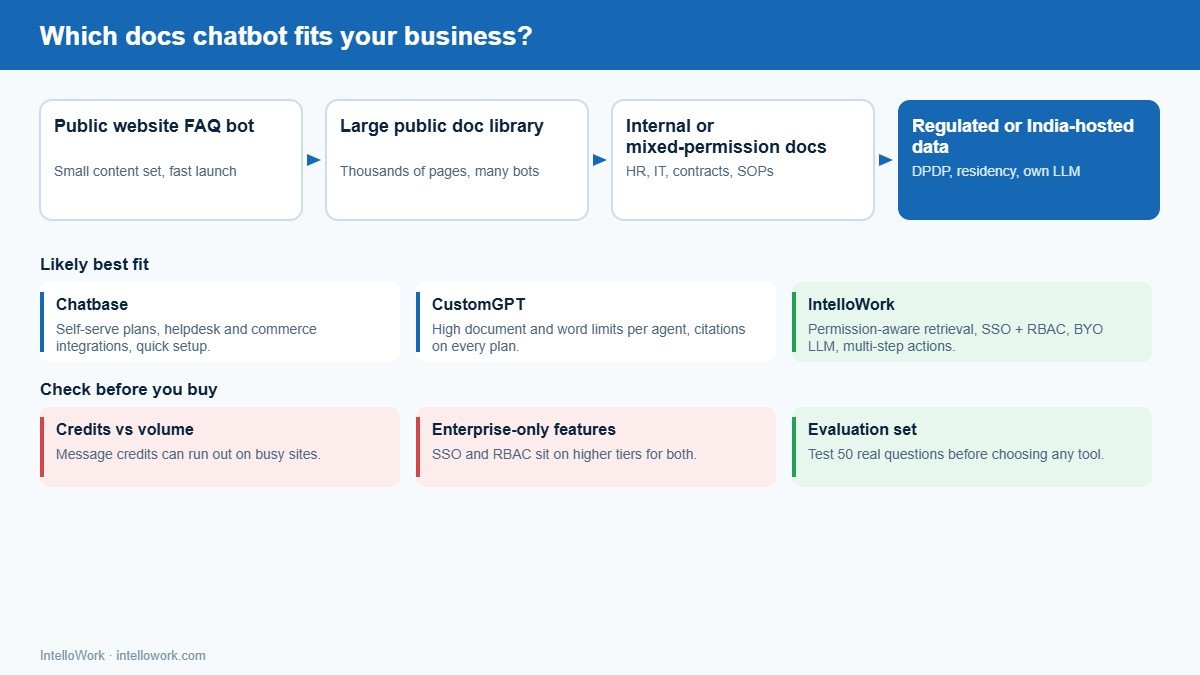
- Choose Chatbase if you want a self-serve website bot live this week, with ready helpdesk, CRM and commerce integrations.
- Choose CustomGPT if you have a large public document library and want citations and anti-hallucination controls on every plan.
- Choose IntelloWork if different users must see different answers, you need SSO and role-based access, or you want to run on your own model and region.
In short, the first two are strongest on speed of setup. IntelloWork, by contrast, is strongest when permissions, integrations and data control matter more than a same-day launch.
How a docs chatbot actually works
All three products follow the same broad pattern, called retrieval-augmented generation. If the term is new, our guide to RAG explains it in depth. Here is the short version, step by step.
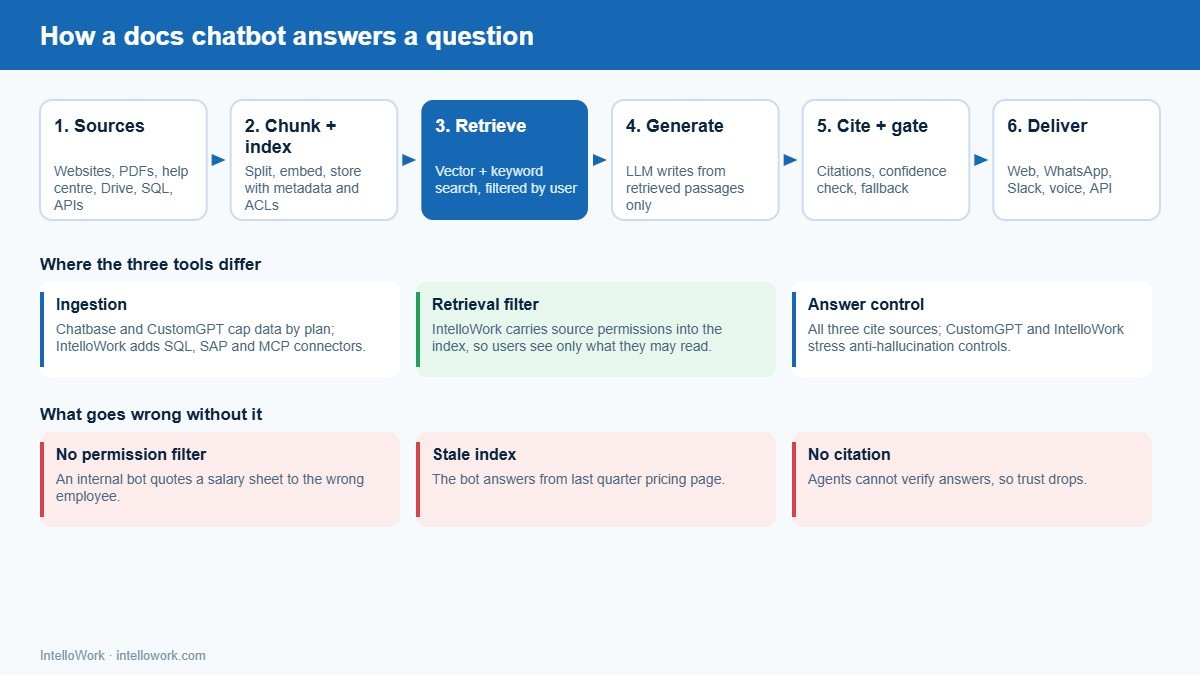
- Input: you connect sources such as a website, PDFs, a help centre, Google Drive or a database.
- Processing: the platform splits content into chunks, turns each chunk into an embedding and stores it with metadata.
- Retrieval: when a user asks something, the system finds the most relevant chunks. IntelloWork uses vector plus keyword search by default and filters results by the user’s permissions.
- Generation: a large language model writes an answer using only the retrieved passages.
- Decision layer: the answer is checked for grounding; weak answers get a disclaimer or a hand-off instead of a guess.
- Output: the reply goes to the web widget, WhatsApp, Slack, voice or an API, with citations attached.
- Monitoring: logs show unanswered questions, low-confidence replies and which sources are used most.
Therefore, the real differences between tools sit in three places: what you can ingest, whether retrieval respects permissions, and how tightly the answer is held to the source. For a closer look at the last point, see our piece on AI chatbot hallucination.
Chatbase vs CustomGPT on pricing and limits
The two self-serve tools meter usage differently. Chatbase counts message credits and training data size, while CustomGPT counts queries, documents and words. As a result, the cheaper option depends on whether you have lots of traffic or lots of content.
| Plan detail | Chatbase | CustomGPT | IntelloWork |
|---|---|---|---|
| Entry paid plan | Hobby, $40/month | Standard, $99/month | Per-workspace pricing |
| Usage metered by | Message credits (700 on Hobby) | Queries (1,000 on Standard) | Workspace plus usage add-ons |
| Content limit | 10 MB training data on Hobby | 5,000 documents per agent on Standard | Scoped per deployment |
| Free option | Yes, 50 credits | No free plan listed | Request access for a trial |
| Remove vendor branding | $99/month add-on | Premium plan and above | Not applicable |
| Source | chatbase.co/pricing | customgpt.ai/pricing | intellowork.com |
Also note what sits on enterprise tiers. Chatbase lists SSO, custom roles and audit logs under Enterprise. Similarly, CustomGPT lists custom SSO and role-based access control under Enterprise. For a wider view of how chatbot pricing models behave at scale, read our enterprise chatbot pricing guide.
Chatbase vs CustomGPT vs IntelloWork: feature comparison
| Criteria | Chatbase | CustomGPT | IntelloWork |
|---|---|---|---|
| Citations | Yes | Yes, on all plans | Yes, to document and section |
| Permission-aware retrieval | Not listed | Enterprise RBAC | Source ACLs carried into the index |
| SSO | Enterprise | Enterprise | Keycloak, Google, Azure AD, Okta, OIDC |
| Channels | Web, WhatsApp, Slack, Messenger, Instagram | Web, integrations | Web, WhatsApp, Slack, voice, API; Teams coming |
| Actions beyond answers | Helpdesk and Stripe-style actions | Mostly Q&A | Multi-step agents over REST, SQL, SAP, MCP |
| Model choice | Vendor-managed | Vendor-managed; more models on Enterprise | Bring your own: OpenAI, Bedrock, Anthropic, self-hosted |
| Security claims | HIPAA-eligible on Enterprise | SOC 2 Type 2, GDPR | SOC 2-aligned, tenant isolation, audit log |
Notably, the IntelloWork entries are the company’s own documented capabilities rather than third-party audits. So the fair test is always your own content, which we cover below.
Where each tool fits best
Chatbase
Chatbase is a good fit for small and mid-sized teams that want a website assistant fast. Its integrations list is long, including Zendesk, HubSpot, Shopify and Stripe, and the Standard plan adds helpdesk and voice features. On the other hand, credit-based metering can surprise busy sites, and the Free plan deletes agents after 14 days of inactivity.
CustomGPT
CustomGPT suits organisations with big public libraries, such as publishers, universities or product companies with deep docs. Its limits are generous on content, and citations come on every plan. Still, the query cap on Standard is 1,000 per month, and SSO with role-based access requires Enterprise.
IntelloWork
IntelloWork is designed for teams where the answer depends on who is asking: an HR assistant that must not leak payroll, an IT helpdesk, or a partner portal. Because source permissions travel into the index, a user cannot retrieve a page they could not open in the original system. It also runs agents that look up records or raise tickets, and it reaches customers on WhatsApp.
A practical example: one question, three tools
Imagine an illustrative Indian SaaS company with public docs, an internal Confluence space and a Google Drive folder of customer contracts. A support agent asks, “What uptime does Acme’s contract guarantee?”
- A public-content bot trained only on the website cannot answer, because the contract is private.
- A bot fed every file with no permissions might answer correctly for the agent, yet it would also answer a curious intern, which is a data leak.
- A permission-aware bot answers the account manager with a citation to the contract clause, while it tells the intern the information is not available to them.
That third behaviour is what IntelloWork is built to deliver. For a public website FAQ, meanwhile, any of the three tools will do the job. If you are still deciding scope, our AI chatbot pilot guide shows how to start small.
Pros and cons of IntelloWork vs Chatbase and CustomGPT
Pros
- Permission-aware retrieval, so one bot can serve staff, partners and customers safely.
- SSO and role-based access built into the product, not only on a top tier.
- Bring-your-own-model and data residency options, which helps with DPDP planning.
- Multi-step agents over REST, SQL, SAP and MCP connections, so the bot can act, not just answer.
- Hybrid vector and keyword search by default, which helps with product codes and exact terms.
Cons
- No public self-serve price list, so you need a conversation to get a quote.
- Microsoft Teams support is listed as coming soon.
- Setting up permissions and connectors takes more planning than uploading a PDF.
- Chatbase lists more ready-made commerce and helpdesk integrations today.
How we measure success in a Chatbase vs CustomGPT vs IntelloWork evaluation
We do not quote made-up accuracy rates. Instead, we recommend scoring any shortlisted tool against the same framework, using your own documents and questions:
| Measure | What to check |
|---|---|
| Answer accuracy | Share of 50 test questions answered correctly |
| Citation quality | Does each citation point to the exact passage? |
| Safe refusals | Does the bot decline when the answer is missing? |
| Permission leaks | Can a low-access test user retrieve restricted content? |
| Latency | Time to first token and to full answer |
| Deflection | Share of conversations resolved without a human |
Then rerun the same set every month, since content and models change. IntelloWork states a median answer latency under three seconds; however, measure it on your own data rather than taking any vendor’s figure on trust.
Frequently asked questions
Is Chatbase or CustomGPT better for a small business website?
For a small public FAQ bot, Chatbase is usually quicker to launch and has a free tier. CustomGPT suits businesses with larger document libraries, since its Standard plan allows 5,000 documents per agent.
What is the main difference in Chatbase vs CustomGPT?
Chatbase prices on message credits and training-data size, and it leans on helpdesk and commerce integrations. CustomGPT prices on queries and document limits, and it emphasises citations and anti-hallucination on every plan.
Where does IntelloWork fit against Chatbase and CustomGPT?
IntelloWork targets teams whose answers sit in mixed-permission sources such as HR, IT or partner documents. It carries source permissions into retrieval, supports SSO and role-based access, and lets you bring your own LLM.
Do Chatbase, CustomGPT and IntelloWork all cite their sources?
Yes, all three can show sources. The difference is how precise the citation is and whether low-confidence answers are flagged or held back.
Can these chatbots keep data in India for DPDP?
IntelloWork lists data residency options and a bring-your-own-model setup, including AWS Bedrock. For Chatbase and CustomGPT, ask the vendor where data and model calls are processed before signing.
How should I test a docs chatbot before buying?
Build a set of 50 real questions with known answers, run them through each shortlisted tool on your own content, and score accuracy, citation quality, refusals and response time.
Talk to us
If your docs chatbot needs to answer staff and customers differently, keep data under your control, or take actions in your systems, IntelloWork is built for that. Request access, and we will index a sample of your real content and let you compare cited answers side by side with your current Chatbase or CustomGPT bot before anything goes live.