Zendesk AI Agent Alternative: 7 Options for Teams That Want Grounded Answers
Updated 21 September 2026
Support teams start looking for a Zendesk AI agent alternative for one of two reasons. Either the bill for automated resolutions has grown faster than the resolution rate, or the bot has confidently told a customer something that is not in the help centre. In fact, both problems come from the same design choice: the AI answers from whatever it can find, and the vendor charges per answer it decides was good. This guide compares seven options for teams that want grounded answers, meaning every reply is traceable to a source document, and explains how to judge them on cost, grounding and control rather than on demo polish.
Why teams look for a Zendesk AI agent alternative
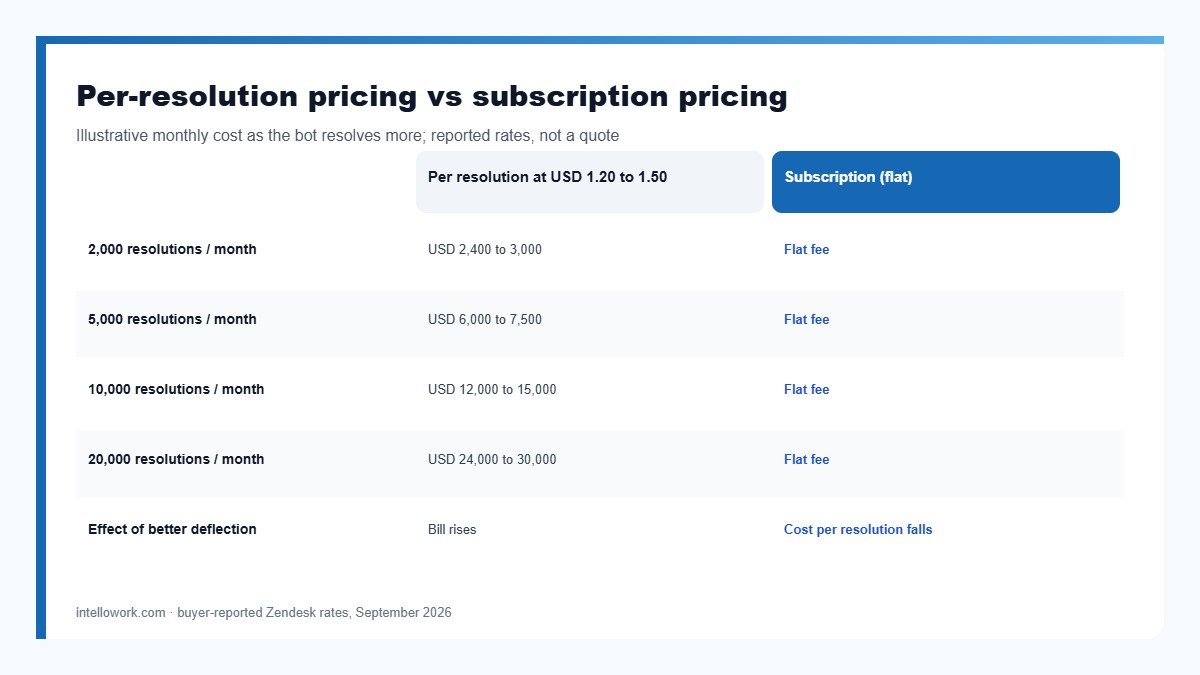
Zendesk’s AI agents are capable, and they sit inside the helpdesk most support teams already use. The friction, however, is elsewhere. Since May 2026, Zendesk bills only for “verified resolutions”, which a second language model judges to be genuine, and buyer-reported rates sit around USD 1.20 to 1.50 per resolution on committed packs, with pay-as-you-go higher. Consequently, a team resolving 20,000 tickets a month through the bot is looking at a five-figure monthly line before seats and the USD 50 per agent Copilot add-on.
Cost is the visible issue. Grounding, meanwhile, is the quieter one. A helpdesk-native bot draws on help centre articles and ticket history, which is fine until the answer lives in a product manual, a Confluence space, a Solr index or an internal policy document that was never published to the help centre. In that situation, the bot either escalates or improvises. Moreover, the market changed in 2026: Zendesk completed its acquisition of Forethought in March, and Salesforce signed an agreement to acquire Fin, formerly Intercom, in September. Two of the largest independent alternatives are now inside the platforms they used to compete with, which is a good moment to re-evaluate.
What “grounded answers” means in a Zendesk AI agent alternative
In a Zendesk AI agent alternative, a grounded answer is one the system can point to. The system generates the reply only from passages it retrieved from your approved sources, it shows those passages as citations, and if it retrieves nothing relevant the bot says so instead of guessing. The technique is retrieval-augmented generation, and we explained it in our post on what retrieval-augmented generation is. The important point for buyers, therefore, is that “uses RAG” is not the same as “is grounded”. Grounding depends on what is indexed, how permissions travel with the content, whether citations are shown, and what the bot does when retrieval comes back empty. Our guide to AI chatbot hallucination covers the failure modes in detail.
How a grounded support agent works
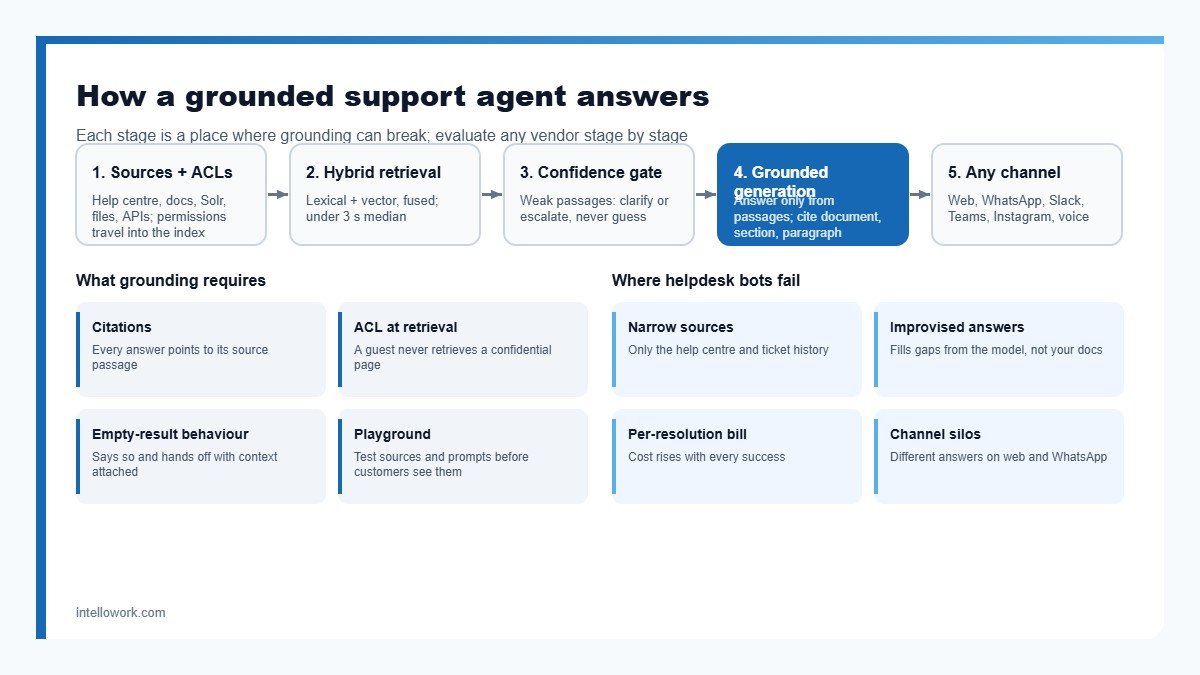
The architecture below is how IntelloWork produces an answer, and it is a useful template for evaluating any Zendesk AI agent alternative, because each stage is a place where grounding can break.
Input: sources and permissions
First, IntelloWork ingests content from wherever it lives: help centres, websites, files, APIs, Confluence, SharePoint and existing Solr or Elasticsearch indexes. Each document also carries its access-control list into the index. As a result, a customer on the web widget can only ever retrieve public content, while a logged-in partner or an internal agent can retrieve what their group is allowed to see.
Processing: chunking and hybrid retrieval
Next, the system splits documents into passages, embeds them, and indexes them alongside their keywords. When a question arrives, the system runs lexical and vector retrieval together and fuses the results, which gives the precision of keyword search with the recall of semantic search. IntelloWork’s median answer latency is under three seconds, including retrieval.
Decision layer: confidence gate
Before generation, the system scores the retrieved passages. If the best passages fall below a threshold, the bot does not answer from general knowledge; it asks a clarifying question or hands off to a human with the conversation and the retrieved context attached. In other words, this gate is what separates a grounded agent from a chatbot with a knowledge base bolted on.
Output: cited answer on any channel
Then the language model answers only from the passages, and the reply shows the source document, section and paragraph. The same answer reaches the web widget, WhatsApp, Slack, Microsoft Teams, Instagram or voice, because the retrieval plane is shared and the channels are just delivery.
Monitoring and action
Finally, the system logs every answer with its citations, so a support lead can review why the bot said what it said. Where a workflow needs more than an answer, action agents look up an order, raise a ticket or book a slot through connected systems, and the action is logged the same way. We cover the governance side in our piece on monitoring internal AI assistants.
A practical example
Consider a payments company with a public help centre, a partner portal with API documentation, and an internal Confluence space on dispute handling. A merchant asks the WhatsApp bot why a settlement is delayed. Retrieval returns the public settlement-timing article and, because the merchant is authenticated, the partner-portal page on weekend cut-offs. The bot never retrieves the internal dispute playbook, because the merchant’s group has no access to it. As a result, the bot answers with two citations. When the merchant follows up with a question about a specific chargeback, the confidence gate sees no matching passage, and the bot escalates the conversation to an agent with the transcript and the two sources already attached.
Zendesk AI agent alternative: 7 options compared
Pricing below comes from published vendor pages and independent buyer-reported benchmarks re-verified in September 2026. Enterprise contracts are negotiated, so treat figures as orientation.
| Option | Pricing model (reported) | Grounding and citations | Sources beyond the helpdesk | Best fit |
|---|---|---|---|---|
| IntelloWork | Per-workspace subscription plus usage-based add-ons; no per-resolution meter | Every answer cited to document, section and paragraph, as well as a confidence gate before answering | Solr and Elasticsearch indexes, websites, files, APIs, Confluence, SharePoint | Teams whose answers live outside the help centre, as well as teams that need WhatsApp, Slack and Teams from one brain |
| Fin (Intercom, now Salesforce) | USD 0.99 per resolution, with a 50-resolution monthly minimum, as well as seats | Grounded in connected content, but assumes resolution if the customer goes quiet for 24 hours | Help centre, connected content, Zendesk and Salesforce integrations | Teams already on Intercom, or else heading into Salesforce |
| Freshworks Freddy AI Agent | Per session, so about USD 49 per 100 sessions | Grounded in Freshdesk knowledge base | Freshworks ecosystem | Freshdesk customers with modest deflection needs |
| Ada | Per conversation and custom, so roughly USD 30K per year at entry | Knowledge-grounded with reasoning engine | Help centre plus integrations | High-volume B2C support at 300K+ conversations a year |
| Decagon | Platform fee around USD 50K per year, as well as usage | Agent operating procedures with grounding | Broad integrations | Large enterprises with budget for a platform programme |
| Sierra | Outcome-based, about USD 1 to 2.50 per resolution, and therefore six-figure contracts | Grounded conversational agents with actions | Enterprise systems | Enterprises wanting a fully managed outcome contract |
| Build your own (open-source RAG) | Engineering time, as well as model and infrastructure costs | As good as you make it | Anything you can connect | Teams with an ML platform, as well as time to own it |
Per-resolution versus subscription pricing in a Zendesk AI agent alternative
When you compare any Zendesk AI agent alternative, the distinction to hold onto is between per-resolution pricing and subscription pricing. Per-resolution pricing looks cheap at low volume, but it punishes success; every improvement in deflection raises the bill. Subscription pricing, in contrast, rewards the team that gets the bot answering more, which is the whole point of deploying one. We worked through the arithmetic in enterprise AI chatbot ROI.
Feature-by-feature: IntelloWork versus Zendesk AI agents
| Criterion | Zendesk AI agents | IntelloWork |
|---|---|---|
| Pricing | Per verified resolution, buyer-reported at USD 1.20 to 1.50, as well as Copilot at USD 50 per agent per month | Per-workspace subscription plus usage-based add-ons; no per-resolution meter |
| Knowledge sources | Help centre and ticket history, as well as connected content | Solr and Elasticsearch, websites, files and APIs, as well as Confluence, SharePoint and product docs |
| Citations | Links to help centre articles | Document, section and paragraph on every answer |
| Permissions | Helpdesk roles | Source-level ACLs enforced at retrieval, as well as SSO with group-to-role mapping |
| Channels | Zendesk messaging channels | Web widget, WhatsApp, Slack, Teams, Instagram and voice, all from one configuration |
| Actions | Native Zendesk actions, then extra action credits | Action agents that look up orders, raise tickets and also book slots through your APIs |
| Testing | Bot builder preview | Playground to test prompts, sources and skills against real questions, before release |
| Data residency | Zendesk regions | Defaults to the Mumbai region (ap-south-1), with EU and US on request; moreover, content is never used to train public models |
| Helpdesk dependency | Requires Zendesk Suite | Works alongside Zendesk or Freshdesk, or even no helpdesk at all |
Zendesk keeps the advantage where the helpdesk is the whole world: ticket routing, agent workspace and reporting are native and mature. As a Zendesk AI agent alternative, IntelloWork is the stronger choice when the knowledge is spread across systems, when permissions matter, or when the same answer has to appear on WhatsApp and inside Teams. Consequently, many teams run both, with IntelloWork answering and Zendesk holding the ticket.
Pros and cons of moving to a Zendesk AI agent alternative
The gains from a Zendesk AI agent alternative are concrete. Cost becomes predictable and falls per resolution as the bot improves. Additionally, answers can draw on documentation the help centre never had. Citations make quality review possible, while permission-aware retrieval makes it safe to point the bot at internal material. Furthermore, one configuration serves every channel, which matters for Indian teams where WhatsApp carries most of the volume.
The costs are real too. For example, a separate answer layer means one more system to administer, and ticket analytics stay split between the bot and the helpdesk unless you integrate them. Grounded agents are also conservative by design, so they escalate questions a looser bot would have attempted, which is the right behaviour but can look like a lower automation rate in the first month. Finally, content quality now matters more; a grounded bot cannot answer a question your documentation does not answer.
How we measure a Zendesk AI agent alternative
IntelloWork does not publish customer performance numbers, so the framework below is what we agree with each team at the start of a Zendesk AI agent alternative pilot. Importantly, every measure is one you can compute from your own logs.
| Measure | Definition | Why it matters |
|---|---|---|
| Grounded answer rate | Share of answers with at least one citation to an approved source | The direct measure of hallucination risk |
| Correct escalation rate | Share of hand-offs where retrieval genuinely had no answer | Shows the confidence gate is tuned, rather than timid |
| Deflection at stable CSAT | Tickets resolved without an agent, while satisfaction holds | Deflection that drops CSAT is cost transfer, rather than saving |
| Cost per resolved conversation | Total monthly cost divided by resolved conversations | Should fall as volume grows, whereas per-resolution pricing keeps it flat |
| Permission violations | Answers containing content outside the user’s ACL | Must be zero, so it is tested in the playground before release |
| Median answer latency | Time from question to cited answer | Customers abandon slow bots, especially on WhatsApp |
Frequently asked questions
What is the best Zendesk AI agent alternative?
It depends on where your answers live. For example, if everything is in the help centre and you want to stay in one vendor, Zendesk’s own agents or Fin are reasonable. If answers are spread across product docs, Confluence, search indexes and internal policies, or you need WhatsApp and Teams from one configuration, IntelloWork is built for that. Meanwhile, Ada, Decagon and Sierra suit large enterprises with platform budgets.
How much do Zendesk AI agents cost?
Zendesk does not publish a rate. Buyer-reported figures in 2026 are about USD 1.20 to 1.50 per verified resolution on committed packs, with pay-as-you-go closer to USD 2, plus Suite seats and a USD 50 per agent Copilot add-on. Since May 2026, moreover, only resolutions confirmed by a verifier model are billed.
Can IntelloWork work alongside Zendesk?
Yes. IntelloWork answers questions and, where needed, raises or updates the Zendesk ticket through an action agent. Agents keep working in Zendesk; meanwhile, the AI layer draws on a wider set of sources than the helpdesk holds.
What does grounded mean for an AI support agent?
A grounded agent answers only from passages retrieved from your approved content, shows citations, and escalates when nothing relevant is retrieved. Above all, it does not fill gaps from the language model’s general knowledge.
Is per-resolution pricing bad?
Not always, and it should not decide your Zendesk AI agent alternative on its own. At low volumes it is cheap and low-risk. The issue, however, is that the cost scales with success, so a bot that goes from 30 to 60 percent deflection doubles the bill. Subscription pricing inverts that, which is why teams with growing volume tend to prefer it.
Does IntelloWork support Indian data residency and DPDP requirements?
Yes. IntelloWork defaults to the Mumbai region (ap-south-1) with EU and US options on request, content is not used to train public models, and consent and access controls are designed around the DPDP Act. See our note on DPDP consent for AI chatbots.
Talk to us
If your automated-resolution bill is rising faster than your deflection rate, or your bot cannot see the documents that hold the answers, IntelloWork is the Zendesk AI agent alternative built for that problem. Request access, and then we will index a sample of your real content, connect it to the channel your customers actually use, and let you compare cited answers against your current bot in the playground before anything reaches a customer.