
Intercom Fin Alternative: AI Support Chatbot That Cites Sources and Costs Less
Updated 18 September 2026
Intercom Fin is a capable product, and any honest comparison should start there. It resolves a large share of routine support questions, it deploys across many channels, and it handles more than 40 languages. Even so, a steady stream of teams begin searching for an Intercom Fin alternative after a few months in production. The reasons are usually specific rather than general: the invoice grows in proportion to success, answers cannot always be traced to a source, and Indian teams find no local data region on offer.
This article compares Fin with IntelloWork on the points that actually decide the purchase. Because both products use retrieval-augmented generation underneath, the architecture argument is less interesting than the commercial and governance ones. For background on the underlying technique, see our explainer on retrieval-augmented generation.
Why teams start looking for an Intercom Fin alternative
Three patterns come up repeatedly in these conversations. Firstly, the pricing model rewards the vendor exactly when the product works. Secondly, support leaders want to show a customer where an answer came from, and that is harder when attribution is not part of the contract. Thirdly, Indian companies preparing for the DPDP Act want processing inside India, which changes the shortlist considerably.
None of these makes Fin a poor choice. Rather, they are the points where a different design makes a measurable difference. Teams running a help centre with modest volume often find Fin entirely appropriate. Teams deflecting tens of thousands of conversations a month, however, start doing arithmetic.
What Fin costs, and when that becomes the problem
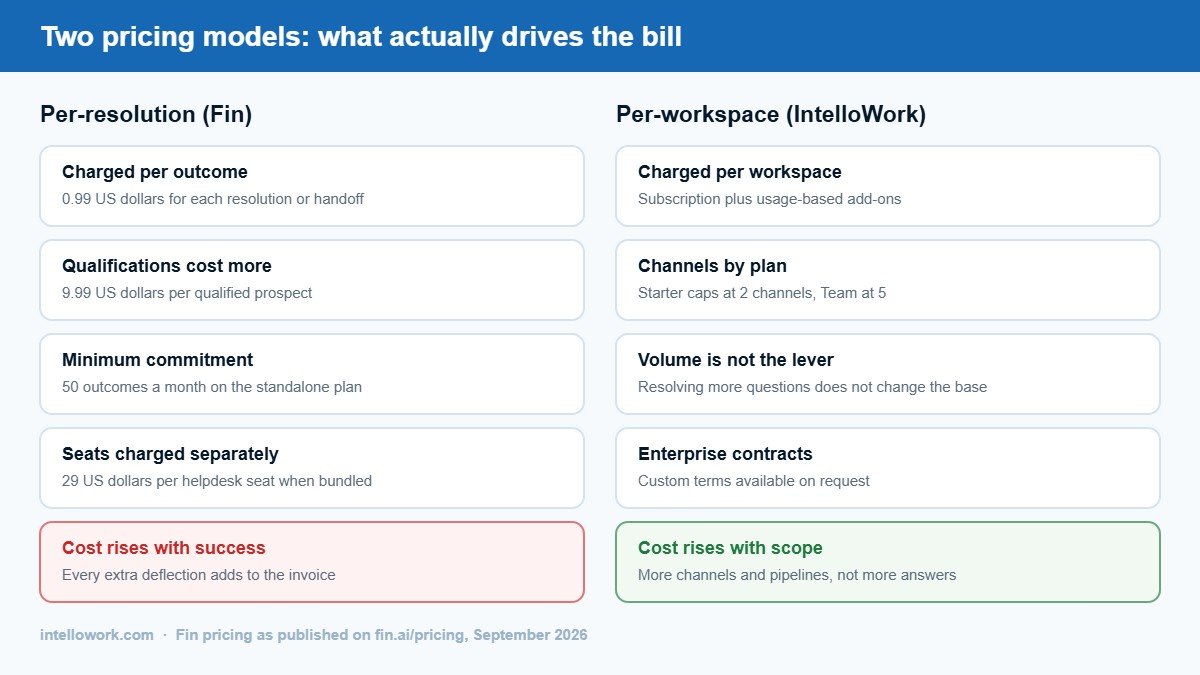
Fin charges per outcome. As published, a resolution or a procedure handoff costs 0.99 US dollars, while a qualification costs 9.99 US dollars. Standalone use carries a minimum of 50 outcomes a month. When Fin is paired with the Intercom helpdesk, seats add 29 US dollars per seat per month on top.
Consequently the bill scales linearly with how well the product performs. The table below simply multiplies the published rate by volume, so you can see the shape of it.
| Resolutions per month | Monthly cost at 0.99 USD | Annualised |
|---|---|---|
| 500 | 495 USD | 5,940 USD |
| 2,000 | 1,980 USD | 23,760 USD |
| 5,000 | 4,950 USD | 59,400 USD |
| 10,000 | 9,900 USD | 118,800 USD |
| 25,000 | 24,750 USD | 297,000 USD |
Arithmetic on the rate published at fin.ai/pricing in September 2026. Helpdesk seats, where applicable, sit on top.
At the lower end this looks reasonable, and often it is. At the upper end the model becomes awkward, because the finance conversation turns into a discussion about capping deflection. That is a strange place to end up, since deflection was the point. IntelloWork prices per workspace with usage-based add-ons instead, so resolving more questions does not by itself move the base cost. Channels are the lever there: Starter allows two, Team allows five.
To be fair to Intercom, per-outcome pricing has a real virtue. You pay nothing when the product fails, which removes the risk of buying software that sits unused. Therefore the right question is not which model is better in the abstract, but which one suits your volume. Our guide to enterprise AI chatbot ROI works through the calculation properly.
How a cited answer is actually produced
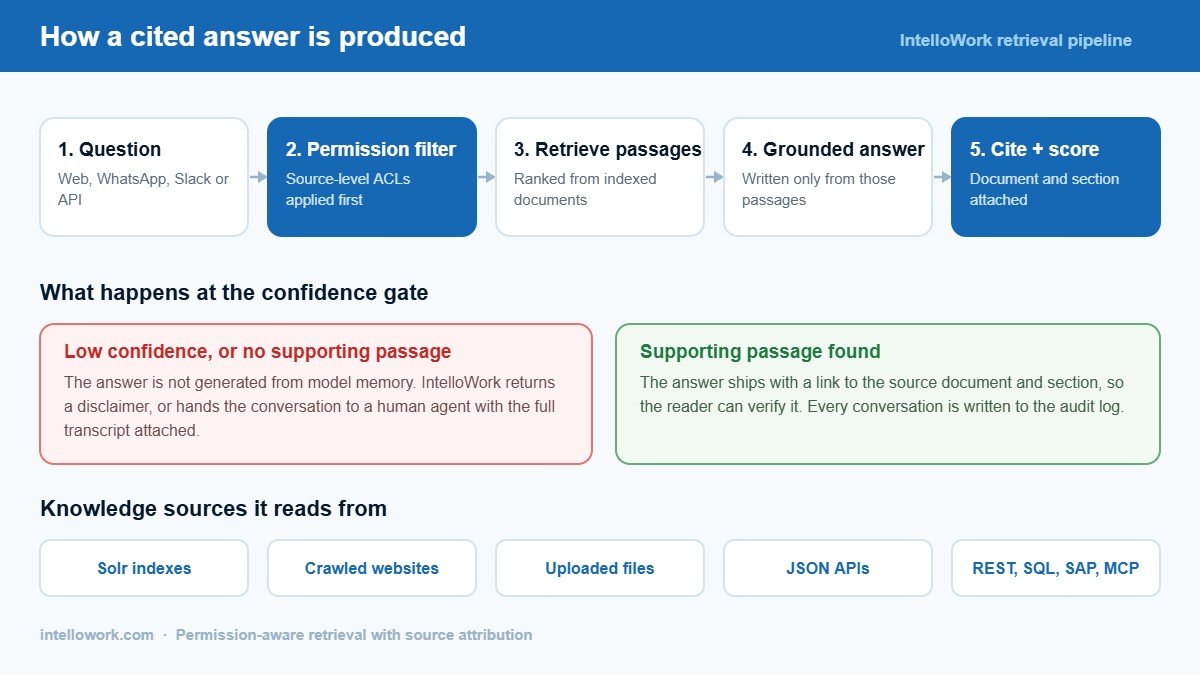
Both products retrieve before they generate, yet the guarantees differ. Here is the IntelloWork sequence, which the diagram above follows.
Input. A question arrives from the web widget, WhatsApp through the Meta Cloud API, Slack, voice or the API directly. Microsoft Teams is on the roadmap.
Permission filter. Before retrieval runs, source-level access controls are applied. Consequently a contractor asking about salary bands sees nothing, because the underlying documents were never in their candidate set. This matters far more for internal deployments than for public help centres.
Retrieval. Relevant passages are ranked from the indexed corpus, which can include Solr indexes, crawled websites, uploaded files, generic JSON APIs and custom REST, SQL, SAP or MCP connections.
Grounded generation. The answer is written from those passages rather than from model memory. Where confidence is low, the reply carries a disclaimer or hands off to a human agent with the transcript attached.
Citation. Finally the answer ships with the document and section it came from, so the reader can verify it. Meanwhile every conversation and configuration change is written to an audit log. Our article on stopping AI chatbot hallucinations covers why grounding alone is not sufficient without that last step.
Intercom Fin alternative compared: the feature-by-feature view
The table sets out published capabilities rather than opinions. Verify anything commercially significant with both vendors, since products move quickly.
| Criterion | Intercom Fin | IntelloWork |
|---|---|---|
| Pricing model | 0.99 USD per resolution or handoff, 9.99 USD per qualification | Per workspace, plus usage-based add-ons |
| Minimum | 50 outcomes a month standalone | Monthly billing, enterprise contracts on request |
| Source attribution | Answers built from retrieved knowledge sources | Document and section attached to the answer |
| Permission-aware retrieval | Oriented to help centre and support content | Source-level ACLs enforced during retrieval |
| Data region | EU workspaces in Europe, AU workspaces currently US-based | Defaults to ap-south-1, with EU and US on request |
| Languages | More than 40, including Hindi and Bengali | Multilingual, configured per pipeline |
| Channels | Messenger, email, WhatsApp, SMS, Facebook, Instagram | Web, WhatsApp, Slack, voice, API, Teams coming |
| Actions | Procedures and handoffs | Action agents, multi-step workflows, CRM writes, booking |
| Identity | Intercom workspace roles | RBAC with Google, Azure AD, Okta or OIDC mapping |
Two things stand out. Fin covers more public social channels, notably Instagram, Facebook and SMS. IntelloWork goes further into internal systems and permissioned retrieval. Accordingly the better fit depends on whether your hardest questions come from customers or from employees, a distinction our guide to internal knowledge base chatbots explores.
Where an Intercom Fin alternative fits best for Indian teams
Data residency is the clearest difference for buyers in India. Fin documents European processing for EU workspaces and US-based processing for Australian ones, with no India region published. IntelloWork defaults to ap-south-1, which is the Mumbai region.
Importantly, this is not a legal requirement in itself. The DPDP Act does not impose general localisation, so processing abroad remains permitted. Nevertheless, sectoral regulators such as the RBI impose stricter rules on regulated entities, and enterprise procurement teams increasingly ask the question regardless. Our piece on DPDP consent for AI chatbots covers the obligations that attach to chat transcripts, while chatbot security and compliance covers the controls buyers audit.
Language is the second factor. Fin supports Hindi and Bengali within its 40-plus languages, so the gap is smaller than vendors sometimes suggest. Still, Hinglish and code-mixed queries behave differently from clean Hindi, which is worth testing directly rather than assuming. See our notes on multilingual chatbots and on WhatsApp deployments.
How we measure success against Intercom Fin
Since every vendor claims high deflection, insist on measuring it yourself during a pilot. The framework below is what we use with customers; treat it as an evaluation method rather than a published benchmark.
| Measure | How to test it |
|---|---|
| Grounded accuracy | Sample 100 answers and check each against the cited passage, not against intuition |
| Citation rate | Share of answers carrying a verifiable source link |
| Escalation quality | Whether handoffs arrive with full context, and how often they were justified |
| Permission correctness | Ask restricted questions from a low-privilege account and confirm nothing leaks |
| Cost per resolved conversation | Total monthly spend divided by resolved conversations, at your real volume |
| Containment without harm | Deflection measured alongside repeat contacts and satisfaction, never alone |
That last measure matters most. Deflection is easy to inflate by declining to escalate, so read it together with repeat contact rate. Our guide to running an AI chatbot pilot sets out a four-week structure for this.
A worked example: a 40-person SaaS support team
Take a Pune-based B2B company handling roughly 9,000 support conversations a month, of which about 6,000 are routine questions about billing, integrations and account settings.
On per-outcome pricing, deflecting 6,000 of those costs 5,940 US dollars a month before seats. Moreover, the team wanted the assistant to answer internal questions from the engineering runbooks too, which sit in Confluence behind access controls. That second requirement is where the evaluation turned, because public help centre content and permissioned internal content are different problems.
They ultimately ran both tools against the same 100 questions, which is the only reliable way to judge an Intercom Fin alternative. Fin performed well on the documented billing queries. On the internal runbook questions, the deciding factor was whether retrieval respected the existing access controls without a separate content migration. Your own result may differ, which is precisely why the test matters more than the comparison table.
Pros and cons of moving off Fin
Where a switch helps. Predictable cost at high deflection volume comes first, since the base does not climb with each resolved question. Source attribution comes second, because it turns a support answer into something a customer can verify. Permission-aware retrieval comes third, which unlocks internal use cases without duplicating content. Finally, Indian data residency simplifies procurement conversations that would otherwise stall.
Where it does not. Fin is deeply integrated with the Intercom helpdesk, so teams already committed to that stack give up real convenience. Fin also covers Instagram, Facebook and SMS, which IntelloWork does not. Additionally, any migration costs time: content review, pipeline configuration and a fresh evaluation set. If your volume is a few hundred resolutions a month, the saving may not justify the effort yet. Honest answer: stay where you are until volume or governance changes the maths.
Frequently asked questions
Is there an Intercom Fin alternative that works with our existing helpdesk?
Yes. IntelloWork deploys as a web widget, on WhatsApp through the Meta Cloud API, in Slack, over voice or directly through its API, and hands off to human agents with the full transcript. Because the assistant sits in front of your helpdesk rather than inside it, you can keep your current ticketing system.
Will an Intercom Fin alternative actually cost less at low volume?
Not necessarily, and it would be misleading to claim otherwise. At a few hundred resolutions a month, per-outcome pricing is genuinely competitive, since you pay only for what works. The economics shift once monthly resolutions run into the thousands, because a per-workspace subscription stops tracking volume.
Does Fin cite its sources?
Intercom documents that Fin builds answers using the most relevant information from your knowledge sources, and its public documentation does not describe per-answer source attribution as a guaranteed output. IntelloWork attaches the document and section to the answer itself. Verify the current behaviour of both during a trial, as these details change.
Can we keep Intercom and add a different AI layer?
Often yes, and several teams do exactly that during evaluation. Running both in parallel on the same question set is the fastest way to get a defensible answer. After that, most teams consolidate rather than keep paying twice.
What about Indian data residency?
IntelloWork defaults to ap-south-1, the Mumbai region, with EU and US options on request. Fin documents European processing for EU workspaces and US processing for Australian workspaces. Remember that the DPDP Act does not mandate localisation generally, though sectoral regulators may.
How long does a migration usually take?
Plan for four to six weeks in most cases. Content indexing and pipeline configuration take days rather than weeks, whereas building a proper evaluation set and running a parallel pilot takes the bulk of the time. Teams with permissioned internal sources should allow longer, since identity mapping needs care.
Talk to us
If your support volume has grown to the point where per-resolution pricing is shaping your deflection strategy, that is the signal to evaluate an Intercom Fin alternative properly. IntelloWork answers from your own documentation, cites the passage it used, respects the access controls you already have, and runs in the Mumbai region by default.
You can try the live demo on intellowork.com or request access to run it against your own content. Bring your hardest hundred questions, because that is the only test that settles the argument.