
AI Chatbot for Healthcare and Hospitals
Updated 1 September 2026
Healthcare organisations run on documents almost nobody can find quickly: clinical SOPs, empanelment and insurance rules, rosters, consent forms, procurement policies, patient-facing instructions. An AI assistant is well suited to that retrieval problem – and badly suited to anything that resembles clinical judgement. Keeping those two apart is the whole design.
Start with the administrative layer
| Audience | Questions worth automating | Fit |
|---|---|---|
| Front desk and admissions | Empanelment lists, insurance and TPA rules, documentation required, tariff questions | Strong – documented, high volume, changes often |
| Nursing and clinical staff | Where the current SOP or protocol document is, and what it says | Strong as retrieval with citation – the clinician decides |
| Billing and claims | Package rules, exclusions, submission checklists, rejection reasons | Strong – rules are written, staff turnover is high |
| HR and operations | Rosters, leave, credentialing, onboarding for a large rotating workforce | Strong – see AI chatbot for HR |
| Patients | Timings, preparation instructions, department information, appointment status | Good, kept strictly to published information |
| Patients – symptoms | What is wrong with me, should I take this medicine | Refuse – route to a clinician |
Note what is missing from the automate column: diagnosis, triage, dosage and anything else that constitutes clinical advice. An assistant deployed in a hospital should decline those explicitly and route the person onward, and it should be tested on exactly those questions before launch.
Retrieval with citations, because the clinician decides
The safe pattern in a clinical setting is not an assistant that answers, but an assistant that finds. A nurse asking which protocol applies should receive the passage and a link to the current controlled document, not a paraphrase. That distinction keeps the human in the decision and makes the interaction auditable.
- Version control matters more than anywhere else. A superseded protocol that remains answerable is a patient-safety issue, not a content-hygiene one. Retirement of a document has to remove it from the index the same day.
- Citations are mandatory, not a feature. Every answer opens the controlled document it came from.
- Refusal is tuned conservatively. Where the corpus is silent, the assistant says so. Test this with a fixed set of questions your content does not answer and count the confident responses.
The controls behind this are in stopping AI chatbot hallucinations.
Patient data, consent and retention
Health information is among the most sensitive categories a deployment can touch, and the safest design collects as little of it as possible. Patient-facing assistants should stay on published information and hand over to a human the moment a conversation turns personal or clinical.
Where personal data is unavoidable – appointment status, for instance – the DPDP obligations are concrete: purpose-limited consent captured before collection, notice at the point of contact, a defined retention period for transcripts, restricted access to raw conversations, and erasure that reaches the vector index and analytics stores rather than only the primary log. The detail is in DPDP Act consent rules for AI chatbots, and the deployment options for keeping everything inside your own boundary in private ChatGPT for enterprises.
Permissions in a multi-role environment
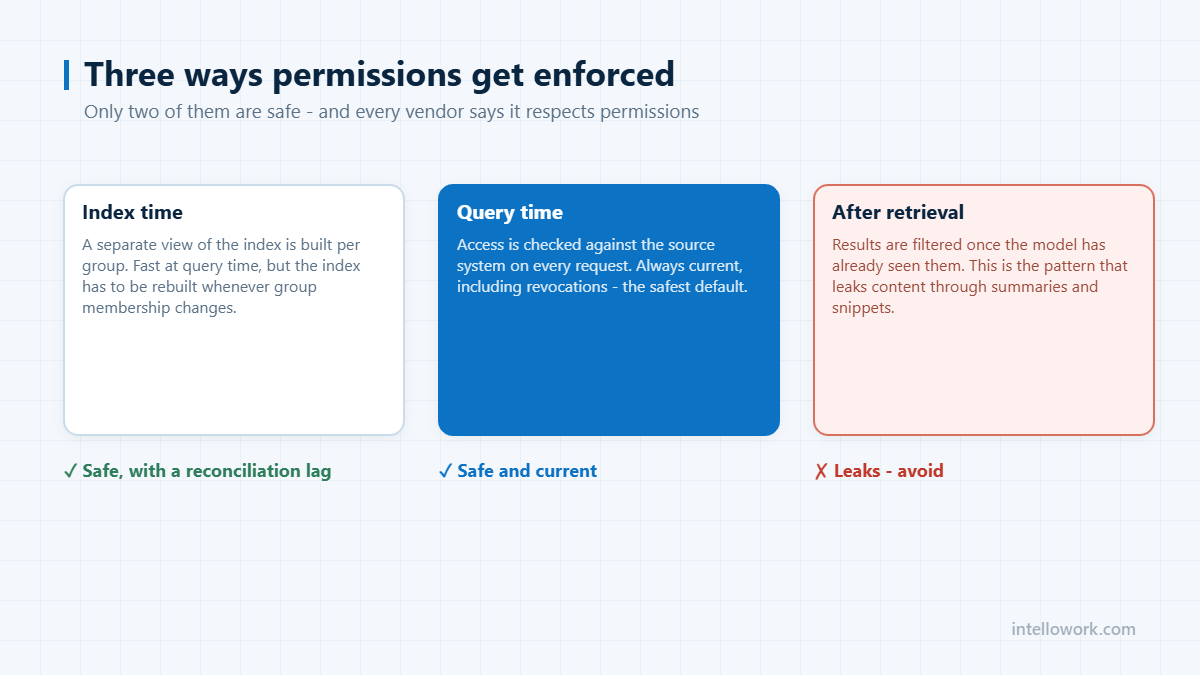
Hospitals have unusually complex access models – department, role, seniority, unit, and often multiple entities under one group. The requirement is the same as anywhere else but harder to satisfy: permissions enforced at query time against the source system, so that content restricted to one department never surfaces in another’s answers, citations or snippets. Test it before launch with a restricted document and an unauthorised user, and test revocation too – when someone rotates out of a unit, how long until the assistant stops answering from that unit’s content?
Languages and the frontline
Frontline healthcare staff and patients ask in several languages, frequently mixing English clinical terms into a regional-language sentence. Systems that translate the query before retrieving lose the clinical terms that make the match work. Retrieval in a shared multilingual space keeps them, so a question asked in Hindi or Tamil still finds the English SOP. See multilingual AI chatbot.
Frequently asked questions
Can an AI chatbot diagnose patients or give medical advice?
No, and a responsibly designed deployment refuses to. Diagnosis, triage, dosage and treatment guidance are clinical decisions that belong with a qualified professional. What an assistant can do safely is retrieve the current protocol, policy or patient instruction with a citation, so the clinician or staff member decides with the right document in front of them.
What can it safely tell patients?
Published, non-personal information: department and timings, preparation instructions for a procedure, documentation to bring, general facility information, and – once identity is established – appointment status. Anything about a person’s condition, medication or results should route to a human.
How do we stop staff getting answers from an outdated protocol?
Treat document retirement as an indexing event. When a protocol is superseded, it must be removed from the index that day, and freshness should be part of your test set: change a document, ask the question it answers, and measure how long until the answer changes. Answers should also always cite the controlled document so the version is visible.
Does patient data leave our environment?
That depends on the deployment you contract for, and it should be settled before a pilot. Ask for the region the index and logs sit in, written confirmation that content is not used to train any model, transcript retention periods, and a deletion guarantee covering derived stores. The lowest-risk design is one where patient-facing conversations collect no clinical information at all.
Where should a hospital start?
With staff-facing retrieval on documented, non-clinical content – insurance and empanelment rules, billing and claims checklists, HR and rostering policy. The volume is high, the content owner is clear, the risk surface is small, and it surfaces the version-control and permission problems before anything patient-facing goes live.
Next step
The sensible first step is a scoped pilot on one administrative content set. Request access at intellowork.com, or read the enterprise AI chatbot platform overview.